Anggika: A Handwritten Font That Builds Connection—Not Just Decoration
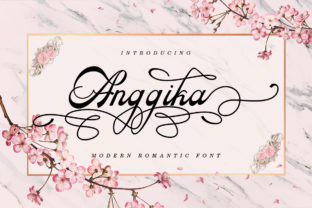
Anggika isn’t just another script font you download and drop into a mockup. It’s a carefully crafted handwritten typeface with expressive ligatures, organic stroke variation, and subtle rhythm—designed to evoke warmth, authenticity, and intentionality. For professionals who rely on visual communication—not as decoration, but as strategy—Anggika offers something rare: a tool that supports human-centered messaging when used deliberately.
Why Anggika Matters Beyond Aesthetics
Most script fonts fall into one of two categories: overly formal (rigid, calligraphic, distant) or overly casual (loose, inconsistent, hard to read at scale). Anggika occupies the middle ground with precision. Its ligatures aren’t decorative flourishes—they’re functional connectors that guide the eye smoothly across words, reinforcing flow and coherence. That matters when your goal is clarity *and* emotional resonance—whether you’re designing an invitation for a boutique wedding brand, crafting a heartfelt email sequence for a coaching business, or laying out a limited-edition zine for educators.
This isn’t about “making things pretty.” It’s about reducing cognitive load while increasing perceived sincerity. Research in typographic perception shows readers assign personality traits to typefaces—and handwritten styles like Anggika consistently score higher on trust, approachability, and care. That’s not incidental. It’s leverage—especially when your audience is making decisions based on credibility, empathy, or shared values.
Strategic Use Cases—Where Anggika Delivers Real Value
Anggika works best where voice, tone, and relationship matter more than speed or neutrality. Consider these grounded applications:
- Brand storytelling assets: Use Anggika for short, high-impact phrases in brand guidelines—taglines, mission statements, or signature quotes—paired with a clean sans-serif for body text. This contrast reinforces both personality and readability.
- Customer-facing microcopy: Handwritten-style fonts perform well in emails, thank-you notes, or onboarding screens where warmth builds retention. Anggika’s ligatures help maintain rhythm even in short lines—avoiding the “choppy” effect common with basic script fonts.
- Educational and creative materials: Teachers using printable worksheets, illustrators designing workshop handouts, or indie publishers typesetting poetry collections all benefit from Anggika’s natural cadence. It signals thoughtfulness without demanding attention away from content.
- Limited physical touchpoints: Letterpress stationery, artisan product labels, or framed studio signage gain tactile credibility with Anggika—provided it’s sized and spaced appropriately for legibility at intended viewing distance.
What to Consider Before You Commit
Using Anggika effectively requires alignment—not just with design preferences, but with audience expectations and operational reality. Ask yourself:
- Is your audience likely to associate this style with credibility—or inconsistency? A financial advisor targeting retirees may find Anggika too informal; a ceramicist launching a new line of handmade mugs? It may feel like a natural extension of their craft.
- Do you have control over rendering environments? Anggika’s ligatures depend on OpenType support. Web use requires proper font loading via
@font-facewithfont-feature-settings, and fallbacks must be planned. Don’t assume every platform—especially email clients or older CMS templates—will display it correctly. - How much time will you invest in refining spacing and hierarchy? Handwritten fonts demand tighter kerning judgment and line-height discipline. What looks elegant at 48pt may collapse at 16pt. Test early, test often, and prioritize function over flourish.
The Risk of Using Anggika Without Strategy
When deployed without clear intent, Anggika can unintentionally undermine goals. Overuse dilutes impact: applying it to full paragraphs, navigation menus, or data tables sacrifices scannability and accessibility. Worse, mismatched usage creates dissonance—a law firm’s homepage using Anggika for “We Fight for Justice” next to sterile legal disclaimers in Helvetica reads as inauthentic, not charming.
It also risks alienating users who rely on assistive technology. While Anggika itself isn’t inaccessible, poor implementation—like embedding text as images or failing to declare language attributes—can break screen reader interpretation. Strategic use means respecting both aesthetic and functional boundaries.
Practical Planning Tips for Intentional Implementation
Start small. Identify one high-leverage, low-risk application: a branded PDF template, a single hero section on your site, or a recurring email signature. Then follow this sequence:
- Define the outcome first. Is the goal to increase open rates? Strengthen brand recall? Humanize a technical service? Let that drive placement—not the other way around.
- Test contrast and legibility in context. Print it. View it on mobile. Zoom to 200%. If the ligatures blur or letters collide, adjust tracking or switch to the standard (non-ligature) variant for that use case.
- Document usage rules—not just for yourself, but for collaborators. Specify where Anggika appears (e.g., “only in headlines up to 60 characters”), which variants are approved (e.g., “ligatures enabled only in print; disabled for web headings”), and what the fallback is (e.g., “Interstate Light if Anggika fails to load”).
- Measure what changes—not just impressions. Track click-through on a CTA button using Anggika vs. a neutral alternative. Monitor time-on-page for landing pages with Anggika-driven headlines. Correlate shifts in engagement with typographic choices, not assumptions.
Long-Term Positioning: Beyond Trend
Trends fade. Tools that deepen connection endure. Anggika endures not because it’s “in,” but because it answers a persistent need: how to communicate with nuance in a world saturated with algorithmic uniformity. That’s why thoughtful practitioners—freelancers building client trust, educators designing inclusive learning tools, small business owners differentiating in crowded markets—return to fonts like Anggika not for novelty, but for fidelity.
Its long-term value lies in consistency—not repetition. When Anggika appears only where it serves a distinct communicative purpose, it becomes part of your brand’s grammar: instantly recognizable, emotionally resonant, and quietly authoritative. That kind of recognition doesn’t come from volume. It comes from restraint, repetition with purpose, and alignment with real human behavior.
Final Guidance: Choose Anggika Like You’d Choose a Partner
You wouldn’t hire a contractor without clarifying scope, timeline, and shared priorities. Treat Anggika the same way. Before licensing or installing it, ask: What problem does it solve? Whose attention does it earn—and whose might it lose? How will you know it’s working?
If your answer is vague (“It just feels right”) or purely aesthetic (“I love the swirls”), pause. Revisit your core objective. Then decide—not whether to use Anggika, but whether Anggika is the most effective tool *for this specific outcome*, at *this specific moment*, with *this specific audience*.
That level of intentionality separates decoration from distinction. And distinction—earned through thoughtful, grounded choices—is what builds lasting value.