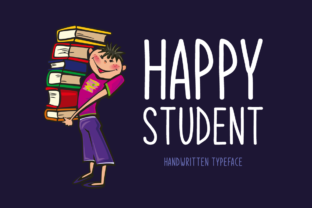
Happy Student: The Handwritten Font That Brings Warmth and Energy to School-Themed Design
Whether you're a teacher crafting classroom posters, a school administrator designing welcome banners, a parent volunteer organizing a PTA event, or a graphic designer building a literacy app for kids—finding the right font can make or break your project’s tone. Happy Student is more than just another handwritten typeface. It’s a carefully crafted, playful yet legible font that radiates approachability, joy, and authenticity—exactly what many education-focused creatives have been missing.
School-themed design often walks a fine line: it needs to feel friendly and inclusive without sacrificing clarity or professionalism. Too formal, and it feels cold or bureaucratic. Too cartoonish, and it undermines credibility or fails to scale across formats. Many designers default to overused script fonts or generic sans-serifs—neither of which fully capture the warmth of learning environments where curiosity, encouragement, and individual expression matter most. That’s where Happy Student steps in—not as a novelty, but as a purpose-built solution.
What Makes Happy Student Different—and Why It Works So Well
Happy Student is a cool and fun handwritten font with a charming, slightly bouncy rhythm and consistent baseline alignment. Unlike some handwritten fonts that sacrifice readability for flair, Happy Student maintains strong letterform distinction—even at smaller sizes—and includes thoughtful spacing and open counters (the enclosed spaces inside letters like “a,” “e,” and “o”). Its lowercase “g” and “y” have subtle, friendly tails; its capital “Q” features a gentle swash; and its numerals are clear and classroom-ready.
It’s not just about aesthetics. This font was designed with real-world usage in mind: printed on bulletin boards, projected onto interactive whiteboards, embedded in digital newsletters, or used in student-facing apps. Because it’s optimized for both screen and print, Happy Student helps ensure your message lands clearly—no squinting, no misreading, no second-guessing whether “b” is a “d.”
Real Challenges—And How Happy Student Helps Solve Them
Many educators and designers face recurring hurdles when bringing school-related visuals to life:
- Lack of visual consistency across materials—from handouts to signage to social media posts.
- Struggling to balance fun and function, especially when communicating with families, administrators, or district stakeholders who expect polish alongside personality.
- Time constraints: Creating custom illustrations or hand-lettered elements isn’t always feasible mid-semester.
- Accessibility concerns, including low contrast, poor letter spacing, or overly decorative glyphs that hinder readability for neurodiverse learners or those with visual processing differences.
Happy Student directly addresses each of these. Its consistent weight, generous x-height, and moderate stroke variation support legibility across devices and distances. When paired with a clean sans-serif for body text (like Open Sans or Montserrat), it creates an accessible, harmonious typographic system—one that feels intentional, not improvised.
Practical Ways to Use Happy Student Across Education Projects
You don’t need to be a professional designer to get great results with Happy Student. Here’s how different users apply it effectively:
For Teachers & Instructional Coaches
Use Happy Student for anchor charts, weekly schedule headers, behavior expectation posters, and student award certificates. Its friendly energy reinforces positive classroom culture—without needing extra clip art or color overlays. Try pairing it with muted pastels or warm neutrals for a calming yet uplifting effect.
For School Communications Teams
When drafting newsletters, event flyers, or welcome packets for new families, Happy Student adds instant warmth to headlines and section dividers. It signals “we’re here to support you”—not “this is official paperwork.” Bonus: because it’s web-friendly (available in WOFF2 and variable font formats), it renders beautifully in email clients and CMS platforms like WordPress or Squarespace.
For EdTech Developers & UX Designers
In learning apps or LMS dashboards, Happy Student works exceptionally well for motivational microcopy (“You’ve got this!”, “Great job on your quiz!”) or playful navigation labels (“Let’s Explore”, “Try Again”). Just avoid using it for long-form instructions or data tables—reserve it for moments where emotional resonance matters most.
For Parent Volunteers & PTA Organizers
If you're designing a bake sale poster, library fundraiser banner, or back-to-school night slide deck, Happy Student gives your materials instant charm and cohesion. It’s easy to install and use in Canva, Google Slides, or Microsoft PowerPoint—no design degree required.
Smart Implementation Tips
To get the most from Happy Student, keep these practical considerations in mind:
- Size matters: Use it at 24pt or larger for print, and no smaller than 20px for web headings. Avoid using it below 16px—even its high legibility has limits.
- Pair thoughtfully: Combine with a neutral, highly readable sans-serif for body copy. Avoid other handwritten or script fonts in the same layout—they’ll compete rather than complement.
- Respect hierarchy: Let Happy Student shine in titles, callouts, and short phrases—not paragraphs. Its strength is emotional punctuation, not exposition.
- Test for accessibility: Ensure sufficient contrast (at least 4.5:1 against background) and avoid light gray text on white. Tools like WebAIM’s Contrast Checker help verify compliance.
Who Benefits Most—and Why
Happy Student serves a broad audience—but its greatest impact is felt by those who prioritize connection over decoration. It’s ideal for educators who want their materials to reflect care and intentionality. It’s valuable for small-district communications teams juggling multiple roles and limited budgets. And it’s especially useful for designers serving bilingual or multilingual schools: its clear letterforms reduce ambiguity for emerging readers and language learners.
Importantly, Happy Student doesn’t ask you to “dumb down” your message—it invites you to humanize it. In an era where students and families are increasingly fatigued by institutional fatigue and digital overload, a font that feels like a smile on paper—or on screen—carries quiet power.
Final Thought: Design With Purpose, Not Just Polish
Choosing Happy Student isn’t about chasing trends. It’s about selecting a tool that aligns with your goals: fostering belonging, reducing cognitive load, reinforcing positivity, and making everyday learning materials feel like they were made *with* people—not just *for* them. Whether you're printing a single classroom sign or launching a district-wide branding initiative, this font offers reliability, warmth, and unmistakable character.
So next time you open your design software or update your school newsletter template, consider reaching for Happy Student. Not because it’s cute—but because it’s capable, considerate, and quietly transformative.