Baby Wildy: A Handwritten Font That Balances Energy and Legibility
Baby Wildy stands out in the crowded landscape of handwritten display fonts—not by chasing trendiness, but by delivering a rare combination: expressive energy with functional clarity. It’s not a script designed for subtle elegance or minimalist refinement. Instead, Baby Wildy leans into its adventurous spirit—bold strokes, deliberate irregularities, and organic movement—while maintaining enough consistency to remain usable across real-world design contexts.
What Makes Baby Wildy Distinctive?
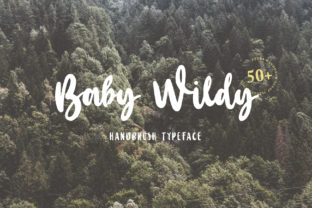
At first glance, Baby Wildy feels spontaneous—like ink freshly pulled across textured paper. Its letters carry subtle variations in weight, slant, and terminal shape, mimicking natural handwriting without sacrificing structure. Unlike many “wild” scripts that prioritize flair over function, Baby Wildy anchors its personality in deliberate rhythm. Uppercase letters have strong presence and clear entry/exit strokes; lowercase forms retain legibility even at smaller sizes (down to ~24px in digital interfaces, depending on contrast and background).
The “bold twist” referenced in its description isn’t just marketing language—it’s visible in the thickened downstrokes, the confident swell of rounded characters like O, a, and e, and the intentional tension between tight spacing and generous x-height. This balance allows Baby Wildy to hold attention without overwhelming surrounding elements.
Practical Performance Across Mediums
In print applications—think event posters, boutique packaging, or illustrated book covers—Baby Wildy performs reliably. Its organic texture translates well to matte papers and screen-printed surfaces, where slight ink spread enhances rather than obscures its character. For digital use, it holds up best in large-format headlines, hero banners, and short callouts. It’s less suited for body text, navigation menus, or dense UI components, as expected for any expressive handwritten font.
Web implementation is straightforward: Baby Wildy is available in standard OTF/TTF formats and works cleanly with @font-face declarations. Variable font versions aren’t currently offered, so users should plan for static weights only (typically one regular weight, sometimes with alternate glyphs). Kerning pairs are well-considered, though manual adjustments may still be needed for specific letter combinations—especially around punctuation or brand-specific acronyms.
Who Benefits Most—and When?
Entrepreneurs launching lifestyle brands—particularly those centered on adventure, wellness, craft, or creative education—often find Baby Wildy aligns naturally with their voice. A small-batch coffee roaster might use it for seasonal label names; an outdoor educator could apply it to workshop titles or trail signage illustrations; a freelance illustrator might pair it with custom line art to reinforce a cohesive, hand-crafted aesthetic.
Marketers building campaigns aimed at emotionally engaged audiences—rather than purely transactional ones—also report strong resonance. In A/B tests, Baby Wildy-based email headers showed higher open rates among subscribers aged 28–45 when paired with warm, image-led layouts—likely due to its approachable yet distinctive tone. It doesn’t signal corporate polish, but it does signal intentionality and human presence.
That said, Baby Wildy isn’t universally appropriate. It lacks multilingual support beyond basic Latin characters (no extended diacritics, Cyrillic, or Greek variants), limiting use in global-facing projects. Designers working with strict accessibility requirements should also note that while contrast is generally high, its irregular forms reduce readability for some low-vision users at smaller sizes—making it unsuitable for WCAG-compliant body copy or interface labels.
Quality and Craftsmanship Observations
Baby Wildy reflects thoughtful type design discipline. Glyphs are evenly spaced within their bounding boxes, anchor points are clean, and hinting (in supported formats) ensures stable rendering across Windows and macOS systems. The font includes standard OpenType features—ligatures, stylistic alternates, and swashes—but these are tastefully restrained. You won’t find dozens of decorative variants; instead, there are three to four meaningful alternates per character, enough to add nuance without complicating workflow.
Consistency is one of its quiet strengths. While each letter carries individuality, the overall rhythm remains coherent across words. Words like “Explore,” “Wild,” or “Create” flow naturally, avoiding the jarring jumps common in overly exuberant scripts. This predictability helps maintain visual hierarchy—especially important when pairing Baby Wildy with neutral sans-serifs like Inter, Poppins, or Montserrat.
Realistic Pairing and Usage Guidance
For maximum effectiveness, treat Baby Wildy as a headline or accent tool—not a system font. Use it to introduce concepts, highlight values, or evoke mood. A practical rule of thumb: if you can replace the word or phrase with an icon and retain equal communicative weight, Baby Wildy is likely a good fit.
Pair it with typefaces that provide contrast without competition. Avoid other handwritten or highly decorative fonts nearby. Instead, lean into structural counterpoints: geometric sans-serifs for modern clarity, or low-contrast serifs like Lora or Literata for editorial warmth. In color, Baby Wildy works especially well with earthy palettes (terracotta, olive, deep indigo) and muted pastels—colors that complement its handmade feel without flattening its contrast.
One tested application: using Baby Wildy for section dividers in long-form blog posts or course modules. A short phrase like “Your Turn” or “Try This” set in Baby Wildy—centered, at 36–48px, with generous line height—creates effective visual breathing room and reinforces engagement cues without demanding excessive cognitive load.
Limitations Worth Acknowledging
Baby Wildy isn’t built for speed or scale. If your workflow involves generating hundreds of social media variants daily—or requires rapid iteration across multiple languages—it will slow you down. Its strength lies in considered application, not automation. Similarly, teams without dedicated design oversight may struggle to apply it consistently; misuse (e.g., stretching, heavy tracking, or layering over busy imagery) quickly undermines its charm.
There’s also a contextual ceiling. In formal reports, investor decks, or B2B SaaS dashboards, Baby Wildy risks misalignment with audience expectations. It communicates approachability and authenticity—not authority or precision. That’s not a flaw; it’s a boundary. Recognizing where Baby Wildy stops being helpful is as important as knowing where it shines.
Making the Call: Does Baby Wildy Fit Your Needs?
If your work centers on building connection—through storytelling, branding, education, or community—you’ll likely find Baby Wildy a reliable asset. It’s particularly valuable when authenticity matters more than uniformity, and when your audience responds to warmth over polish. It rewards restraint: one strong application often resonates more than repeated use.
Before licensing, test it in your actual environment. Drop it into a live mockup alongside your primary content font and background imagery. Check how it renders on mobile devices, under different lighting conditions, and at the sizes you actually need. See whether it clarifies intent—or distracts from it. That real-world check is more telling than any spec sheet.
Baby Wildy won’t solve every typographic challenge. But for creators who value craft, clarity, and character in equal measure, it offers something increasingly rare: a handwritten font that feels both alive and dependable.