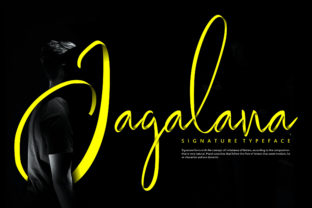
Jagalana: Authentic Sophistication, Instantly
If you’ve ever scrolled past a book cover, boutique packaging, or an Instagram story and paused—not because of the image, but because the text *felt* quietly confident—you’ve likely seen Jagalana in action. It’s not loud. It doesn’t shout. But it carries presence: refined, grounded, and unmistakably human. Jagalana is a premium serif typeface with subtle calligraphic warmth—think fine stationery pressed into cotton paper, not sterile vector lines. Its letterforms balance structural clarity with gentle modulation: soft terminals, modest contrast between thick and thin strokes, and just enough rhythm to feel intentional without feeling fussy.
Where Jagalana Earns Its Keep
Jagalana thrives where authenticity and quiet authority matter most. It’s not built for body copy at 10pt on a mobile screen—but it excels where attention is earned, not demanded. Think logo design for artisan bakeries, independent publishers, or wellness studios that value craft over trend. In editorial design, it anchors headlines in literary magazines or long-form newsletters, giving weight to ideas without overwhelming the reader. On packaging—especially for small-batch goods like olive oil, ceramics, or botanical teas—Jagalana conveys care in both material and message. Its serifs read as deliberate, not decorative; its spacing feels generous, never cramped.
Social media graphics benefit, too—but selectively. A single-line quote overlay on a muted background? Jagalana adds gravitas. A carousel slide introducing a speaker series? Its measured proportions support hierarchy without competing with imagery. It’s also a strong candidate for wedding invitations, studio letterheads, or limited-edition print runs where tactile quality and typographic nuance are part of the experience—not an afterthought.
What Jagalana Does for Your Brand (and What It Doesn’t)
Typography isn’t neutral. Jagalana shapes perception by reinforcing values: tradition with intention, elegance without pretension, craftsmanship without fuss. When used consistently across touchpoints—say, a logo, website hero headline, and printed catalog—it strengthens brand recognition through visual continuity. That consistency isn’t about repetition; it’s about resonance. Readers begin to associate that particular serif warmth with your voice, your pace, your standards.
But Jagalana won’t fix weak hierarchy. If your layout lacks clear visual flow, no font will rescue it. And while it reads beautifully at 24–60pt in print or high-res digital displays, it’s not optimized for UI labels, data tables, or dense paragraph blocks. That’s not a limitation—it’s a signal. Jagalana invites you to slow down, choose carefully, and prioritize impact over coverage. It rewards thoughtful application, not blanket deployment.
Pairing Jagalana Thoughtfully
Jagalana pairs best with typefaces that respect its quiet confidence—not compete with it. A clean, low-contrast sans serif (like Inter, Clarity City, or even a restrained Helvetica Neue Light) creates balanced contrast: Jagalana brings character; the sans brings neutrality and legibility for supporting text. Avoid overly geometric or high-contrast sans serifs—they can clash tonally, making Jagalana feel either stiff or dated.
For editorial layouts, try pairing it with a warm-textured serif for body copy—something like Adobe Garamond Pro or Chaparral Pro. The shared serif DNA creates harmony, while differences in x-height and stroke modulation keep the hierarchy distinct. With script fonts? Use sparingly—and only if the script shares Jagalana’s organic rhythm. A tight, angular script will jar; a loose, ink-trail script might complement it in a very specific context (e.g., a signature line beneath a Jagalana headline).
Testing Before You Commit
Before licensing Jagalana, test it in your actual environment—not just a font specimen sheet. Drop it into a real mockup: a product label at actual size, a web banner at 120% zoom, a newsletter header next to your current body font. Pay attention to how it behaves at different weights. Jagalana typically includes Regular, Medium, SemiBold, and Bold—no italics or condensed variants. That’s intentional. Its strength lies in its focused range, not versatility. If your project needs heavy emphasis *and* italic alternatives *and* narrow widths, Jagalana may not be the right fit—and that’s okay.
Also check readability in context. Does the ‘a’ or ‘g’ hold shape at smaller sizes? Does the spacing tighten uncomfortably when tracking is adjusted? Print a few lines at 18pt on uncoated stock—does the ink spread soften the serifs too much? These aren’t flaws; they’re cues about where Jagalana belongs.
Licensing, Legitimacy, and Long-Term Fit
Jagalana is a commercial font, meaning it requires a license for use in client work, products, or public-facing assets—even if you’re a solo designer or micro-business owner. Most reputable vendors offer perpetual licenses with clear terms for web, desktop, app, and ePub use. Read the license. Seriously. Some bundles include variable font options; others don’t. Some allow unlimited projects, others cap usage per year. There’s no “one-size-fits-all” here—and Jagalana’s value increases when you know exactly what you’re allowed to do with it.
This matters for E-E-A-T (Experience, Expertise, Authoritativeness, Trustworthiness). Using a properly licensed, well-documented font signals professionalism—not just to clients, but to platforms and collaborators. It also protects you from unexpected takedowns or legal friction down the line, especially if your design ends up on merchandise, in an app, or embedded in a SaaS dashboard.
Finally, ask yourself: does Jagalana serve the audience—or just your aesthetic preference? A tech startup targeting Gen Z developers might find its warmth misaligned with their speed-and-clarity ethos. But a heritage watchmaker launching a new limited edition? Jagalana’s restraint and tactility reinforce legacy without leaning on cliché. It’s not about being “on-trend.” It’s about being *on-point*.
So before you drop it into your next project, pause. Look at your goals, your medium, your audience’s expectations—not just your mood or your Pinterest board. Jagalana works best when it’s chosen with purpose, not impulse. When it fits, it doesn’t just look right. It feels inevitable.