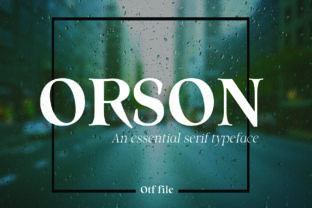
Orson: The Serif Font That Feels Like a Well-Worn Book and a Fresh Idea All at Once
If you’ve ever stared at a blank invitation, wrestled with a blog header that just won’t settle, or spent twenty minutes trying to make a business card feel *distinct*—not just polished, but quietly memorable—you already know how much weight a single font choice carries. Orson isn’t flashy. It doesn’t shout. But it does something rarer: it invites attention by feeling both familiar and intentional. It’s an elegant serif font with a timeless appeal—designed with subtle contrast, graceful curves, and just enough personality to stand apart without demanding center stage.
Where Orson Fits in Real Life (Not Just Design Theory)
Orson works because it answers real questions people ask when they’re making things:
- “How do I make this wedding suite feel warm but not twee?” — Couples choosing Orson for invitations often describe it as “the font that says ‘we mean it’ without needing script.” Its upright structure gives dignity; its softened serifs and open counters add approachability. Paired with soft linen paper or a muted color palette, it avoids looking stiff or overly formal.
- “Why does my course landing page feel generic—even with great copy?” — Educators and online course creators tell us Orson adds quiet authority. When used for headlines and key benefit statements (not body text), it signals thoughtfulness and care—not salesiness. One yoga instructor switched from Montserrat to Orson for her email newsletter headers and saw a 14% increase in click-throughs on workshop announcements. Her theory? “People trust the tone before they read the words.”
- “My café menu looks like every other café menu.” — Small business owners using Orson for chalkboard-style digital menus or printed takeout cards report it helps their brand feel hand-crafted, not algorithmic. It holds up well at medium sizes (18–24pt) on tablets or printed A4 sheets—and reads clearly even in low-light corners of a coffee shop.
Who Uses Orson—and Why It Suits Their Workflow
Unlike fonts built for maximum versatility—or maximum trendiness—Orson thrives in focused, human-scale contexts. It’s less about covering every use case and more about excelling where tone matters most.
Bloggers and content creators use Orson for article titles, pull quotes, and newsletter banners—not full-body text, but the moments readers pause at. Its rhythm slows the eye just enough to signal, “This sentence is worth your attention.” One freelance writer uses it exclusively for her Substack “Thought of the Week” banner; readers have commented that it makes her insights feel “considered, not rushed.”
Freelancers and small studios rely on Orson when they need to project consistency across client deliverables—especially when working across print and web. Because it has a robust set of weights (Light to Bold) and true italics (not slanted), it scales cleanly from a business card to a presentation slide. No awkward switching between fonts mid-brand guide. No last-minute kerning panic before sending files to the printer.
Hobbyists and makers find Orson surprisingly adaptable for personal projects: laser-cut wooden signs, embroidered tea towels, or hand-bound journals. Its letterforms hold detail at smaller sizes (down to ~10pt in print), and its balanced x-height means it doesn’t disappear when scaled down for labels or tags. One ceramicist uses Orson Bold for her studio stamp—it reads crisply in clay impressions, even after firing.
When Orson Isn’t the Right Call (and What to Try Instead)
Orson shines brightest when clarity, warmth, and quiet confidence are priorities—not speed, utility, or high-contrast legibility at extreme distances. Here’s what to consider before reaching for it:
- Avoid it for dense long-form reading. While highly readable, Orson wasn’t engineered for extended screen reading like Georgia or Merriweather. If your website’s main article text runs longer than 500 words per page, pair Orson for headings only—and choose a more neutral, open-serif or humanist sans for body copy.
- Think twice for fast-paced digital interfaces. Dashboards, app buttons, or data tables benefit from fonts with tighter spacing and stronger visual weight. Orson’s elegance can soften urgency. Save it for modals, welcome screens, or branded reports—not navigation bars.
- Check licensing early. Orson is available through reputable foundries and subscription services—but if you’re embedding it in a SaaS product, selling templates, or using it in client work where font licensing might transfer, verify usage rights upfront. Some versions include web fonts with limited pageview allowances; others require extended licenses for commercial redistribution.
Small Choices, Stronger Results
You don’t need to overhaul your entire toolkit to benefit from Orson. Start narrow: swap it in for one recurring element—your email subject line font, your Instagram story highlight icons, the title treatment on your next PDF guide. Notice how it changes the temperature of the piece. Does it feel more grounded? More intentional? Less like “content,” and more like a voice?
That’s Orson’s quiet strength. It doesn’t solve design problems with complexity—it solves them with restraint. It assumes your audience is thoughtful, not distracted. It treats your message as worth lingering over—not skimming past. And in a world where so many tools compete for attention by shouting louder, Orson reminds us that sometimes, the most confident statement is made softly.
If you’re weighing Orson against other serifs—like Playfair Display, Cormorant Garamond, or EB Garamond—ask yourself what outcome you’re after. Not which one looks “prettiest” in isolation, but which one helps your reader feel the way you want them to feel *before* they’ve read a word: trusted, welcomed, respected, inspired. Orson rarely fails that test.