Paper Plate Font
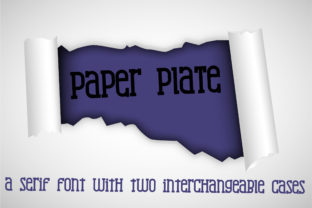
If you’ve ever scrolled through a font library and paused—not because something looked “professional” or “clean,” but because it made you smile—chances are you’ve already felt the quiet charm of Paper Plate. This isn’t just another serif typeface. It’s a thoughtfully crafted, gently playful serif with a distinctive blocky rhythm that feels handmade without sacrificing legibility or structure.
A Serif That Stands Out—Without Shouting
Paper Plate balances contrast and consistency in a way few display serifs do. Its letterforms have modest stroke variation—enough to feel warm and human, not mechanical—but avoid extreme thin-to-thick transitions that can weaken readability at smaller sizes. The “blocky” quality comes from slightly squared terminals, softened corners, and generous x-heights that give lowercase letters presence and clarity—even in tight spaces like mobile interfaces or compact print layouts.
What makes Paper Plate especially useful is its intentional restraint. Unlike many whimsical fonts that lean heavily into illustration or novelty, Paper Plate stays typographically grounded. You can set body copy in it at 16–18px on screen and still maintain flow. It works in headlines, subheads, pull quotes, and even short-form UI labels—provided hierarchy and spacing are respected.
Where Paper Plate Fits in Real Workflows
Think beyond “cute logos.” Paper Plate thrives where personality meets purpose—especially when authenticity matters more than formality.
- Educators and curriculum designers use Paper Plate for handouts, classroom posters, and digital learning modules where approachability encourages engagement—particularly with younger learners or neurodiverse audiences who respond well to clear, friendly shapes.
- Independent publishers and zine makers choose it for title pages, chapter headers, and cover typography. Its tactile quality translates beautifully to risograph printing, letterpress, or textured paper stock—enhancing physicality without compromising reproducibility.
- Small business owners and local shops integrate Paper Plate into signage, packaging, and social media graphics to signal warmth and intention. A bakery might pair it with a neutral sans-serif for ingredient lists—using Paper Plate only for the shop name and tagline—to evoke craft, care, and homemade sincerity.
- Bloggers and content creators apply it selectively: as a headline font over clean web-safe text (like Inter or Source Sans), or in illustrated quote cards shared across Instagram or Pinterest. Its visual weight holds attention without competing with imagery.
Branding With Nuance—Not Just Novelty
Using Paper Plate in branding requires thoughtful layering. It’s rarely the sole voice—but it’s often the memorable accent. Consider how a sustainable apparel brand uses it only for product names (“Haven Tee,” “Clay Duster”) while relying on a sturdy geometric sans for navigation, sizing charts, and policy text. That contrast builds hierarchy *and* reinforces values: craftsmanship in naming, clarity in function.
One common misstep? Overextending Paper Plate into dense paragraphs or long-form editorial contexts. Its character shines brightest in controlled doses—where readers pause, absorb, and connect emotionally before moving on. That’s not a limitation; it’s a design strength.
Digital Use: Performance and Practicality
Paper Plate performs well in modern web environments—especially when served as WOFF2 with appropriate font-display: swap settings. It renders crisply across iOS, Android, and desktop browsers, and its modest file size (typically under 60KB for Latin glyphs) keeps loading impact minimal.
For accessibility, ensure sufficient color contrast—its medium-weight serifs benefit from at least a 4.5:1 ratio against backgrounds. Avoid using it for pure decorative purposes (e.g., text-as-image banners) where screen readers can’t interpret meaning. When used as live text with semantic HTML headings (, ), it supports both usability and SEO intent—especially when paired with descriptive, keyword-aware heading text.
Pairing Paper Plate Thoughtfully
Its natural partners are typefaces that offer counterbalance: neutral sans-serifs with open apertures (like Inter or Source Sans Pro), or low-contrast serifs like PT Serif. Avoid pairing it with other high-personality fonts—like brush scripts or ultra-condensed grotesques—unless the context intentionally leans into maximalism (e.g., festival posters, limited-edition merch).
In print, consider ink spread and paper absorption. On uncoated stock, Paper Plate’s blocky terminals hold shape better than fine hairlines—making it more forgiving in offset or digital print runs than delicate Didones or high-contrast slab serifs.
When to Choose—And When to Pause
Paper Plate excels when your goal is to humanize, invite, or gently differentiate—not dominate or distract. It’s ideal for projects where tone carries equal weight to information: welcome emails, onboarding flows, workshop materials, boutique packaging, or personal portfolio sites.
It’s less suited for enterprise dashboards, legal disclaimers, multilingual interfaces requiring extended glyph sets (though many versions now include basic Latin Extended-A), or situations demanding strict corporate typography guidelines that prohibit expressive serifs.
Before licensing or embedding, verify the license covers your use case—especially if distributing via apps, SaaS platforms, or client-facing templates. Some Paper Plate variants include variable axes (weight, width), which add flexibility but may require additional technical setup.
Final Thought: Typography as Tone
Choosing Paper Plate isn’t about chasing trendiness—it’s about recognizing that typeface choice is one of the most immediate ways to communicate attitude, care, and intention. In a landscape saturated with algorithmically optimized, frictionless fonts, Paper Plate offers something quieter but equally powerful: the feeling that someone paid attention—not just to what’s being said, but to how it’s being received.
Try setting a single sentence in Paper Plate beside the same sentence in a default system font. Notice where your eye lingers. That subtle pause? That’s where connection begins.