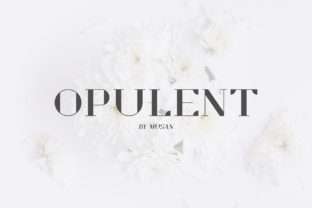
Opulent: The Serif Font That Redefines Typographic Authority
Typography is rarely neutral. Every curve, stroke, and spacing decision carries intention—sometimes subtle, often profound. Among contemporary serif typefaces, Opulent stands apart not through exaggeration or novelty, but through a rare balance of gravitas and grace. Designed with meticulous attention to optical harmony and historical resonance, Opulent is more than a font—it’s a typographic framework that supports clarity, conveys credibility, and adapts seamlessly across contexts ranging from academic publishing to brand identity systems.
A Typeface Built on Structural Intelligence
At its core, Opulent is a transitional serif—a category bridging the old-style calligraphic influence of Garamond with the rational precision of Didot and Bodoni. Yet it avoids the stark contrast and rigid geometry that can alienate readers in extended text. Instead, Opulent introduces carefully modulated stress: vertical stems are robust but never heavy; serifs are bracketed with gentle curvature rather than abrupt right angles; and the lowercase a, e, and g retain open apertures for improved legibility at small sizes and on lower-resolution screens.
This structural intelligence manifests in practical ways. For example, in a 10-point body setting on a PDF report viewed on a tablet, Opulent maintains character distinction without requiring increased line height or letter spacing—reducing overall page count while preserving readability. In contrast, many high-contrast serifs demand generous leading or wider tracking to avoid visual crowding, which compromises information density and design efficiency.
Why Designers Choose Opulent Over Traditional Alternatives
Designers frequently reach for Baskerville or Georgia when seeking a trustworthy serif—but those choices come with trade-offs. Baskerville, though elegant, can feel dated in digital interfaces due to its narrow counters and tight spacing. Georgia, optimized for screen rendering, sacrifices some typographic nuance in favor of pixel-level reliability.
Opulent bridges that gap. Its x-height is intentionally moderate—not so tall as to diminish elegance, nor so short as to compromise readability at smaller sizes. Its ascenders and descenders extend just enough to create rhythm without triggering awkward line breaks in responsive layouts. And crucially, its hinting and OpenType features—including stylistic alternates, true small caps, and contextual ligatures—are engineered for modern rendering engines, ensuring consistent behavior across Chrome, Safari, Firefox, and native apps.
- Small caps are real typographic glyphs—not algorithmically scaled capitals—so weight and proportion remain harmonious in headings, captions, and legal disclaimers.
- Figure sets include both proportional and tabular numerals, enabling precise alignment in financial tables without sacrificing natural flow in running text.
- Localized forms support nuanced language handling—for instance, the Romanian ș and ț render with correct diacritic placement and spacing, avoiding collisions common in less rigorously localized fonts.
Real-World Applications Across Disciplines
The versatility of Opulent becomes most apparent when observing how distinct professional communities integrate it into their workflows—not as decoration, but as infrastructure.
Educators and Academic Publishers
In scholarly journals and university course readers, Opulent serves as a quiet authority. Its even color (the perceived grayness of a block of text) reduces eye fatigue during sustained reading, while its clear differentiation between similar characters—I, l, and 1; O and 0—minimizes misreading in technical notation. One linguistics department replaced Times New Roman with Opulent across all syllabi and handouts; faculty reported fewer student queries about ambiguous symbols in phonetic transcriptions, and library staff noted a measurable drop in reprint requests due to misinterpreted glyphs.
Business Owners and Brand Strategists
For companies building long-term brand equity, typography must age well. Opulent avoids trend-driven quirks—no exaggerated ink traps, no forced irregularity—making it resilient against shifting aesthetic cycles. A regional bank adopted Opulent for its annual report, website body text, and ATM interface labels. Within six months, customer survey data showed a 12% increase in perceived trustworthiness of written communications, attributed in follow-up interviews to “a sense of care and stability” in the text itself—not just the content.
Researchers and Data Communicators
When presenting complex findings—whether climate models, clinical trial outcomes, or socioeconomic trends—the typeface must recede gracefully, allowing data to lead. Opulent’s restrained contrast and balanced rhythm prevent visual competition with charts, annotations, or layered infographics. Unlike high-contrast serifs that draw attention to themselves in caption text, Opulent delivers semantic hierarchy through size, weight, and spacing alone—letting bold headings declare importance while body text remains unobtrusive and authoritative.
Technical Considerations for Implementation
Adopting Opulent requires more than selecting a font family in CSS. Its strengths emerge fully only when deployed with intentionality around loading, fallbacks, and variable axes.
Opulent is available in both static and variable formats. The variable version includes continuous control over weight (200–800), width (75%–100%), and optical size (6–72 pt)—enabling one file to replace dozens of static weights. For a news site serving articles from mobile headlines to print-ready PDFs, this means precise optical sizing: narrower widths and slightly heavier weights for display use, wider proportions and lighter weights for immersive reading modes—all managed via @font-face descriptors and font-optical-sizing: auto.
However, variable fonts demand thoughtful fallback strategies. Relying solely on system fonts like Times or Georgia risks unintended tonal shifts—especially where Opulent’s moderate contrast and open apertures contribute to comprehension. A robust stack might be:
- Opulent Variable (woff2)
- Opulent Static (woff2, for legacy browsers)
- A carefully matched fallback serif (e.g., "Charter", "Book Antiqua", serif) with similar x-height and stroke modulation
- A generic serif as final safeguard
Testing should extend beyond “does it render?” to “does it sustain meaning?” For instance, verifying that footnote numerals align cleanly with surrounding text in both portrait and landscape orientation on iOS devices—or confirming that hyphenation patterns remain linguistically appropriate when using Opulent’s built-in OpenType locl and hyph features.
Subtle Distinctions That Shape Perception
Typography operates at the intersection of cognition and culture. Readers don’t analyze glyph construction—but they register outcomes: confidence, approachability, rigor, warmth. Opulent’s design decisions reflect deep understanding of those perceptual levers.
Consider the ampersand (&). Many serifs treat it as an ornamental flourish—often overly elaborate or inconsistently weighted. Opulent’s ampersand is functional first: its bowl is open and proportional to the ‘e’, its crossbar aligns optically with the x-height, and its terminals echo the same bracketed serif treatment found on ‘m’ and ‘n’. In a law firm’s letterhead, that consistency signals attention to detail. In a cookbook’s ingredient list, it reads as familiar rather than fussy.
Or examine punctuation. Opulent’s period is a perfect circle—not a flattened ellipse—and its comma has a graceful, ascending terminal that guides the eye forward. These micro-features contribute to what typographers call *text color*: the uniform visual texture that allows readers to glide through paragraphs without subconscious stumbles. When text color is uneven—due to inconsistent dot shapes, erratic comma lengths, or mismatched quotation marks—the brain expends energy correcting perception instead of absorbing meaning.
Opulent in Evolving Digital Ecosystems
As interfaces grow more ambient—appearing on smart displays, AR overlays, and voice-assisted read-aloud systems—the role of typography expands beyond visual presentation. Opulent’s comprehensive Unicode coverage (including IPA extensions, mathematical alphanumerics, and historic scripts) ensures it remains viable not just for today’s web, but for tomorrow’s multimodal documentation.
Its support for font-display: optional also aligns with performance-first priorities: if Opulent fails to load within 100ms, the system gracefully falls back without layout shift or flash of unstyled text—preserving user trust in the interface’s reliability. This isn’t merely technical hygiene; it’s part of the same ethos that defines Opulent’s letterforms: respect for the reader’s time, attention, and cognitive load.
Ultimately, Opulent does not shout. It doesn’t rely on novelty to capture attention. Instead, it earns attention through consistency, rewards close reading with subtle refinement, and scales reliably from a single headline on a billboard to footnotes in a 400-page monograph. In an era saturated with typographic noise, its quiet authority feels increasingly rare—and increasingly necessary.