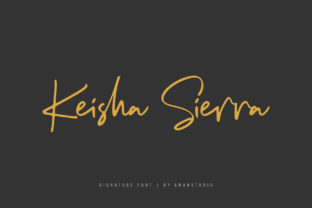
Keisha Sierra: A Handwritten Font That Builds Authentic Connection—When Used With Purpose
Keisha Sierra is more than a stylish typeface. It’s a carefully crafted handwritten font with an incredibly authentic feel—fluid, warm, and human in its imperfections. Unlike many script fonts that lean into exaggerated flourishes or sterile uniformity, Keisha Sierra balances spontaneity with legibility, rhythm with restraint. Its natural stroke variation, subtle ink texture, and organic baseline shift make it feel like it was written by hand—not generated by algorithm. That authenticity isn’t decorative. It’s functional. And when applied intentionally, Keisha Sierra can support real strategic outcomes: stronger brand resonance, clearer audience alignment, and more memorable communication.
Why Authenticity Matters in Today’s Visual Landscape
Consumers—and especially the 20–50 demographic—are increasingly attuned to visual tone. They don’t just read your words; they interpret your typography as part of your voice. A polished sans-serif signals efficiency and clarity. A bold serif conveys tradition and authority. Keisha Sierra, by contrast, signals approachability, care, and individuality. That’s not trivial. In contexts where trust is earned through perceived humanity—think small business websites, educator newsletters, artisan packaging, or freelance service pages—Keisha Sierra helps reduce psychological distance. It doesn’t shout. It invites.
But here’s what matters most: authenticity only works when it aligns with intent. Using Keisha Sierra on a corporate compliance document or a technical API documentation site creates dissonance—not charm. The value isn’t in the font itself, but in how well it matches your goal, audience, and message hierarchy.
Strategic Use Cases—Where Keisha Sierra Delivers Real Value
Not every project benefits from handwriting. Keisha Sierra shines in specific, high-impact scenarios—especially where emotional resonance supports functional outcomes:
- Brand storytelling assets: Landing pages, “About Us” sections, or founder-led email campaigns where warmth and personality strengthen credibility.
- Creative product packaging: Small-batch skincare, handmade ceramics, or indie stationery—where tactile language reinforces premium, artisan positioning.
- Educational materials for engaged audiences: Workshop handouts, downloadable reflection guides, or course welcome sequences where readability meets approachability.
- Personalized marketing touchpoints: Birthday emails, client thank-you notes, or limited-edition campaign headers—moments where differentiation matters more than scalability.
- Social media visuals with narrative weight: Quote graphics, behind-the-scenes announcements, or launch teasers where tone carries equal weight to content.
In each case, Keisha Sierra isn’t used to “make it pretty.” It’s used to reinforce a decision—to signal that this message comes from a person, not a system.
How to Apply Keisha Sierra Without Undermining Clarity or Credibility
Handwritten fonts carry risk if misapplied. Legibility drops at small sizes. Hierarchy blurs when overused. Tone misfires when mismatched. To avoid those pitfalls, start with constraints—not aesthetics:
- Define the primary action you want the viewer to take. Is it to read a short headline? Scan a list? Feel reassured before clicking “Book Now”? Keisha Sierra works best for top-of-funnel emotional cues—not dense body text or data tables.
- Reserve it for one clear typographic role per layout. Use it exclusively for headlines, logos, or pull quotes—not body copy, captions, or navigation. Pair it with a neutral, highly legible companion font (like Inter, Lato, or Source Sans) to anchor the design.
- Test at real-world size and context. View it on mobile screens, in email clients, and embedded in PDFs. Does the “a” still read as an “a” at 18px? Does the “g” retain shape when rendered via web font fallbacks? Don’t assume.
- Consider loading performance and licensing. Keisha Sierra is typically delivered as a variable or static OTF/TTF. If embedding on high-traffic sites, weigh file size against impact. Confirm licensing covers your use case—especially for client work or SaaS platforms.
These aren’t restrictions. They’re filters—designed to keep usage intentional, not incidental.
What Happens When Keisha Sierra Is Used Without Strategy?
Random application erodes its power. When Keisha Sierra appears inconsistently—on a homepage banner but not the contact page, in a social graphic but not the email signature—it reads as decorative rather than deliberate. Worse, overuse dilutes recognition: if everything feels handwritten, nothing feels special.
There’s also a subtler risk: mistaking aesthetic warmth for strategic alignment. A wellness coach using Keisha Sierra across all touchpoints may signal empathy—but if their service delivery is rigid, automated, or impersonal, the font becomes dissonant. Typography amplifies voice; it doesn’t replace substance. Keisha Sierra won’t compensate for unclear messaging, poor UX, or inconsistent service delivery. It highlights what’s already there.
Long-Term Positioning: Beyond the First Impression
Think beyond single-use. Consider how Keisha Sierra fits into your broader visual language over time. Will it scale with your growth? A solopreneur launching a coaching practice might use Keisha Sierra in their logo and hero section—then gradually introduce supporting elements (icons, color accents, illustration style) that echo its rhythm and warmth. That builds cohesion without repetition.
For educators building course ecosystems, Keisha Sierra can become a signature element in module titles or reflection prompts—creating visual continuity across weeks of material. For publishers designing limited-run zines or print anthologies, it adds tactile distinction that digital-first fonts rarely achieve.
The key is consistency of purpose—not consistency of placement. You don’t need Keisha Sierra on every page. You need it where it serves a clear function: to humanize, to differentiate, or to invite.
Practical Planning Tips for Intentional Implementation
Before adding Keisha Sierra to your next project, ask these questions:
- What emotion or impression do I want this specific element to convey—and does Keisha Sierra support that, or compete with it?
- Who will interact with this most? Will they see it on a phone screen while multitasking—or printed and held in hand?
- Is this meant to be scanned quickly (e.g., a call-to-action button), or absorbed slowly (e.g., a brand manifesto)?
- Does my current font pairing create enough contrast in weight, x-height, and tone—or will Keisha Sierra get lost?
- If I removed Keisha Sierra entirely, would the core message weaken, or just look different?
If the answer to the last question is “just look different,” reconsider. Impact comes from alignment—not ornamentation.
Final Thought: Keisha Sierra as a Decision-Making Tool
Treat Keisha Sierra not as a design asset, but as a decision-making checkpoint. Every time you reach for it, you’re implicitly answering questions about audience, intention, and authenticity. That makes it useful far beyond aesthetics—it sharpens your thinking about why you’re communicating, who you’re speaking to, and what feeling you hope to leave behind.
Used without reflection, it’s decoration. Used with clarity, it becomes part of your strategy—a quiet but consistent signal that what you offer is human-made, thoughtfully delivered, and meaningfully aligned.