Jack Mania: A Handwritten Font That Balances Elegance and Contemporary Clarity
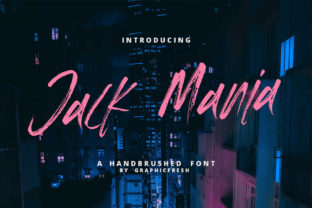
Jack Mania stands apart in the landscape of handwritten display fonts—not by exaggerating quirks or leaning into nostalgia, but by sustaining a rare equilibrium. It’s neither overly formal nor casually unrestrained. Instead, Jack Mania offers a refined, flowing script with consistent letter spacing, subtle contrast in stroke weight, and carefully considered entry/exit strokes that guide the eye without distraction. Its elegance feels intentional, not inherited; its modernity comes from restraint, not ornamentation.
What Makes Jack Mania Distinct—Beyond “Handwritten”
Many fonts labeled “handwritten” rely on irregular baseline shifts, heavy texture overlays, or exaggerated ligatures to simulate authenticity. Jack Mania avoids those tendencies. Its rhythm is steady, its x-height generous, and its lowercase forms maintain legibility even at smaller sizes—unusual for a script font. Uppercase letters retain presence without dominating; lowercase “a”, “g”, and “y” feature open, accessible counters rather than tightly closed loops. These are practical design decisions, not stylistic afterthoughts.
This balance makes Jack Mania functional where other scripts falter: in short headlines paired with clean sans-serif body text, on minimalist packaging, or as a focal point in digital interfaces where readability and tone must coexist. It doesn’t shout—it invites attention through quiet confidence.
Fitting Into Real-World Design Contexts
Jack Mania works best when it serves a clear role—not as background texture, but as a deliberate voice. Consider these realistic applications:
- Brand identity systems where warmth and sophistication coexist—think boutique skincare lines, independent book publishers, or artisanal food brands seeking distinction without cliché.
- Digital touchpoints like email headers, landing page hero text, or app onboarding screens where a human touch reinforces trust without compromising scannability.
- Print collateral such as wedding invitations, limited-edition posters, or editorial pull quotes—where typographic hierarchy benefits from contrast between Jack Mania’s fluidity and a neutral, structured companion font.
It’s less suited for long-form body copy, multilingual layouts with complex diacritics (it supports basic Latin characters but lacks extended language coverage), or environments requiring strict accessibility compliance for large-scale text blocks. Those aren’t flaws—they’re boundaries of fit.
How Jack Mania Compares With Other Script Approaches
Not all handwritten fonts occupy the same design territory. Understanding categories helps clarify where Jack Mania sits—and where it doesn’t:
- Calligraphic scripts (e.g., fonts modeled after broad-nib pen work) emphasize dramatic thick-thin transitions and often prioritize historical accuracy over versatility. Jack Mania simplifies those contrasts, favoring consistency and adaptability across mediums.
- Brush-style fonts lean into texture, irregularity, and energetic movement. They excel in youthful, dynamic contexts—but can feel visually fatiguing alongside dense content. Jack Mania’s smoother flow allows longer visual engagement.
- Monoline scripts eliminate stroke variation entirely, resulting in even, geometric forms. While highly legible, they sometimes lack expressive nuance. Jack Mania reintroduces gentle modulation—enough to feel hand-drawn, not so much that it sacrifices clarity.
This positioning means Jack Mania isn’t competing with every script font—it’s an alternative for designers who need handwriting that breathes, but doesn’t overwhelm; that feels personal, but remains professional.
Practical Tradeoffs to Acknowledge
No font solves every problem, and Jack Mania is no exception. Its strengths come with natural limitations:
- Limited weight range: Jack Mania is typically offered in a single regular weight. That supports cohesion but restricts typographic hierarchy within the family itself—you’ll need a complementary sans-serif or serif for bold or light variants.
- Optical sizing considerations: Like many script fonts, Jack Mania performs most effectively at larger sizes (24px and up on screen, 18pt+ in print). At smaller scales, some letterforms begin to merge visually, especially in tight tracking scenarios.
- Pairing dependency: Its elegance relies partly on contrast. Used alone—or alongside similarly decorative fonts—it can lose impact. It thrives when anchored by a neutral, well-proportioned companion (e.g., a humanist sans like Lato or a crisp serif like Merriweather).
These aren’t dealbreakers—they’re decision points. If your project requires multiple weights within one family or extensive small-size usage, Jack Mania may require supplemental solutions rather than serving as a standalone system.
When Jack Mania Is Likely the Right Choice
Consider Jack Mania if your goal is to communicate approachability without informality, refinement without rigidity, or individuality without eccentricity. It fits well when:
- You’re building a brand voice that values authenticity but operates in a mature, discerning market—say, a financial advisory service targeting high-net-worth individuals who appreciate warmth alongside expertise.
- Your layout depends on strong visual hierarchy, and you need a headline font that draws focus while leaving room for supporting typography to carry information clearly.
- You’re working across both digital and print, and need a script that translates consistently—without relying on texture effects that degrade on screen or fail in CMYK conversion.
- You value craft in type design: Jack Mania reflects thoughtful spacing, balanced proportions, and restrained detail—qualities that age well and resist trend fatigue.
When Another Option Might Serve Better
Jack Mania may not be optimal if:
- Your audience skews toward technical or highly functional contexts—such as enterprise software dashboards or regulatory documentation—where neutrality and predictability outweigh expressive qualities.
- You need broad language support (e.g., Central/Eastern European, Turkish, or Vietnamese diacritics) beyond standard Western Latin characters.
- You’re designing for users with low vision or reading differences and require robust accessibility features—like OpenType stylistic sets for simplified forms or built-in variable axes for weight or width adjustment.
- Your timeline includes tight development constraints and you need web font loading optimization out of the box—Jack Mania files are well-structured, but like most quality display fonts, they benefit from thoughtful subsetting and loading strategies.
In those cases, evaluating alternatives isn’t about finding “better”—it’s about matching tool to task. A simpler monoline script, a versatile variable sans-serif with handwritten-inspired italics, or a purpose-built UI font may deliver more appropriate functionality.
Making a Grounded Choice
Selecting a font like Jack Mania shouldn’t hinge on aesthetics alone. Ask yourself: What role does typography play in this project’s communication goals? Who will read it—and under what conditions? What existing assets, constraints, and standards shape the environment it will live in?
Jack Mania earns its place when those questions point toward clarity, warmth, and timelessness—not novelty or trend alignment. It’s a choice rooted in intention, not impulse. And like any well-considered design decision, its value becomes clearer not in isolation, but in how it supports meaning, enhances usability, and endures beyond the moment it was selected.