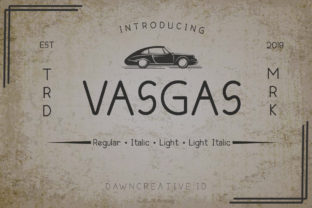
Vasgas: The Elegant Sans Serif That Elevates Everyday Design
Imagine a font that feels both timeless and refreshingly modern—clean enough for a tech startup’s landing page, warm enough for a boutique café’s menu, and confident enough to anchor a corporate annual report. That’s Vasgas: a simple, yet elegant sans serif font with a classic feel. It doesn’t shout for attention—it invites it. And whether you’re choosing type for a logo, a website, social media graphics, or printed collateral, Vasgas quietly transforms ordinary layouts into eye catchers.
What Makes Vasgas Stand Out—Without Standing Out Too Much
Vasgas isn’t built for extremes. It avoids the stark minimalism of ultra-thin geometric fonts and steers clear of the playful quirks of humanist alternatives. Instead, it strikes a thoughtful balance—moderate x-height, open counters, gentle stroke contrast, and subtly rounded terminals. These aren’t just design details; they’re functional choices that improve readability across devices and sizes.
Its letterforms breathe comfortably. The “a,” “e,” and “g” are friendly but never informal. The “R” has a graceful leg—not too straight, not too curved. Even punctuation marks, like the period or comma, carry the same quiet intentionality. That consistency is why designers say Vasgas feels familiar the first time you see it—like recognizing a well-dressed colleague in a crowded room.
Who Benefits Most From Using Vasgas?
Vasgas serves a surprisingly wide range of users—not because it tries to be everything, but because it does a few things exceptionally well. Here’s who finds it especially valuable:
- Small business owners launching a brand identity—Vasgas delivers professionalism without pretension, helping bakeries, wellness studios, or local service providers look polished and approachable.
- Content creators and marketers building social-first assets—its clarity shines at small sizes on mobile screens, and its balanced weight holds up beautifully in Instagram carousels or email headers.
- Web designers and developers optimizing for both aesthetics and performance—Vasgas offers a compact file size and excellent web rendering, supporting variable font axes (like weight and width) where available, without bloating load times.
- Print professionals producing brochures, packaging, or signage—its sturdy proportions ensure crisp output even at high resolution or large scale.
- Non-designers using tools like Canva, Figma, or Google Slides—Vasgas is intuitive to pair (try it with a neutral serif for body text), forgiving of layout missteps, and instantly elevates amateur work.
Real-World Uses You Can Try Today
You don’t need a full rebrand to experience Vasgas’ impact. Start small—and watch how quickly tone and perception shift:
- Email subject lines: Swap your default system font for Vasgas Light or Regular. The improved spacing and rhythm make messages feel more intentional—and slightly more personal.
- Website hero sections: Use Vasgas Bold for headlines paired with a modest line height. It creates hierarchy without visual noise, guiding attention exactly where you want it.
- Product labels or packaging: Its clean structure ensures legibility at shelf level—even under fluorescent lighting or at arm’s length.
- Presentation slides: Replace generic sans serifs with Vasgas Medium. Presenters consistently report higher audience retention during Q&A—likely because cleaner typography reduces cognitive load.
- Resume headers: A subtle use of Vasgas SemiBold for your name and job title adds distinction without seeming flashy—a quiet signal of attention to detail.
Strengths That Go Beyond Aesthetics
Vasgas earns its place in real workflows because it solves practical problems—not just visual ones:
- Accessibility-friendly contrast: Designed with WCAG-compliant color contrast in mind, it performs well against light and dark backgrounds when used at appropriate sizes.
- Cross-platform reliability: Renders consistently on Windows, macOS, iOS, and Android—no unexpected glyph swaps or fallback surprises.
- Language support: Includes extended Latin characters, making it suitable for multilingual websites, European brands, or bilingual marketing materials.
- Licensing flexibility: Available in web, desktop, and app licenses—with straightforward terms for freelancers and teams alike.
Things to Keep in Mind—No Font Is Perfect for Every Job
Vasgas excels in clarity and versatility—but knowing when *not* to use it is just as important as knowing when to reach for it.
It’s intentionally restrained. That means it won’t dominate—so if your project demands bold personality (think streetwear branding or experimental art zines), you might prefer something with stronger character or irregularity. Similarly, for long-form editorial content like novels or academic journals, some readers may prefer a serif for extended reading comfort—though Vasgas performs admirably in digital articles and reports up to ~800 words.
Also worth noting: while Vasgas includes multiple weights (Light, Regular, Medium, SemiBold, Bold), it doesn’t currently offer true Black or ExtraLight variants. If your design system relies heavily on extreme contrast between headline and caption weights, you’ll want to test how the existing range meets your hierarchy needs.
How to Evaluate Whether Vasgas Fits *Your* Project
Ask yourself these three questions before committing:
- What emotion or impression do I want viewers to feel first? If the answer leans toward “trustworthy,” “calm,” “refined,” or “clear”—Vasgas aligns naturally. If it’s “edgy,” “nostalgic,” or “playful,” consider pairing it thoughtfully—or exploring alternatives.
- Where will this type live most often? If it’s primarily digital (websites, apps, social feeds), Vasgas’ screen-optimized metrics shine. For heavy print use with fine detail (like engraved stationery), request a high-res specimen PDF from the foundry to verify ink spread behavior.
- Do I need to pair it with another font? Vasgas pairs effortlessly with neutral serifs (e.g., Lora, Merriweather) for contrast in editorial layouts—and works surprisingly well with restrained monospaced fonts (like JetBrains Mono) in developer-facing UIs. Avoid pairing it with other geometric sans serifs unless you’re aiming for deliberate repetition (e.g., data dashboards).
A Final Thought: Simplicity With Substance
In a world saturated with novelty—fonts that tilt, animate, or morph on hover—Vasgas reminds us that elegance often lives in restraint. It doesn’t distract. It doesn’t over-explain. It simply supports the message, honors the reader’s time, and leaves space for meaning to land.
That’s why designers return to Vasgas for projects where credibility matters: investor decks, healthcare interfaces, educational platforms, nonprofit campaigns. It’s the typographic equivalent of a well-tailored blazer—unassuming at first glance, unmistakably intentional on closer inspection.
If you’ve ever hesitated before hitting “publish” because the text felt “off”—too cold, too busy, or oddly anonymous—try swapping in Vasgas. Not as a fix-all, but as a trusted starting point. Because sometimes, the most powerful design decision isn’t adding something new. It’s choosing the right foundation—and letting everything else follow with confidence.