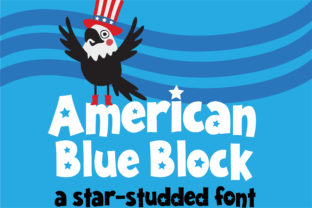
American Blue Block: Bold, Star-Studded Sans Serif
When a font feels like a handshake—confident, friendly, and unmistakably American—chances are you’re looking at American Blue Block. It’s not just another sans serif. Its blocky letterforms carry weight and presence, while subtle star motifs embedded in characters like the “A”, “B”, and “O” add quiet thematic resonance. No glitter, no gimmick—just thoughtful design that nods to heritage without leaning on cliché. That balance makes it unusually versatile: equally at home on a food truck wrap, a classroom poster, or a boutique brand’s Instagram story.
What Makes American Blue Block Stand Out
American Blue Block is built for legibility and character—not one at the expense of the other. Its uppercase-heavy structure gives it natural impact at medium to large sizes, but its even stroke weight and open counters keep it readable in shorter text blocks too. Unlike many “themed” fonts that sacrifice function for flair, this one was designed with real-world use in mind: spacing is generous, kerning is consistent, and the star details are subtle enough to disappear at smaller sizes—so they enhance, not distract.
The blue in the name isn’t arbitrary. While the font itself is neutral (it renders cleanly in black, white, or any brand color), its visual tone evokes clarity, trust, and grounded energy—the kind of feeling that supports credibility in education, local business, or civic communication. Designers appreciate how it pairs effortlessly with clean serifs (think Merriweather or Cormorant Garamond) or pared-down system fonts (Inter, Helvetica Now) for contrast without conflict.
Creative Applications Across Real Projects
Here’s where American Blue Block moves beyond decoration into utility:
- Small business branding: A neighborhood bakery in Ohio used it for their chalkboard menu headers and takeout bag stamp—keeping warmth and authenticity while standing out from handwritten competitors.
- Educational materials: A middle school history teacher applied it to unit title slides and timeline banners. Students reported the visuals “felt serious but not stiff”—a rare win when balancing engagement and academic tone.
- Digital campaigns: A nonprofit running voter registration drives paired American Blue Block with high-contrast photography and minimal copy. The font anchored each social tile with clarity, helping key actions (“Register”, “Learn”, “Vote”) land faster.
- Printed ephemera: Wedding invitations, festival posters, and community garden signage all benefit from its confident simplicity. One designer noted it “holds up under ink bleed and low-res printing better than most display fonts.”
Adapting It Thoughtfully—Not Just Stylistically
Using American Blue Block well isn’t about slapping it on everything. It’s about matching its inherent qualities to your goal:
If your aim is immediacy—like a pop-up shop sign or event banner—use it large, single-weight, with ample whitespace. Avoid stacking multiple font weights or adding heavy shadows; let its structure speak.
If your goal is connection, especially with local or values-driven audiences, pair it with photography that shows real people and places—not stock silhouettes. The font’s sincerity works best when the imagery shares that same grounded quality.
For digital interfaces, treat it as a display face only. Use it for headlines, buttons, or section dividers—not body text. On websites or apps, combine it with a highly legible, accessible sans serif (like Open Sans or Roboto) for paragraphs. This preserves hierarchy and meets WCAG contrast guidelines without compromising voice.
Staying Consistent Without Sounding Repetitive
Consistency doesn’t mean uniformity. You can maintain brand coherence with American Blue Block while keeping things fresh by varying:
- Color application: Try deep navy on cream paper for a heritage feel, or electric blue on charcoal for modern energy. Avoid red unless it’s part of a deliberate, balanced palette—too much red + stars can unintentionally lean into overused patriotic tropes.
- Layout rhythm: Alternate tight letter-spacing for bold statements (“FARM TO TABLE”) with looser tracking for longer phrases (“Since 1987 • Family Owned”). Let the font breathe differently depending on emphasis.
- Supporting elements: Simple line work, subtle halftone textures, or restrained geometric borders complement its blockiness without competing. Skip ornate flourishes—they dull its directness.
Who Benefits Most—and How to Start Smart
Freelancers building portfolio sites often choose American Blue Block for “About” or “Services” headers—it conveys capability without pretense. Bloggers covering travel, food, or local culture find it reinforces authenticity in featured post titles. Educators use it to signal importance without intimidation—on rubrics, handouts, or classroom norms posters.
If you're evaluating whether it fits your project, ask two practical questions:
- Does this need to be noticed quickly—and remembered clearly?
- Does the tone call for confidence, clarity, or quiet pride—not flash or irony?
If both answers are yes, American Blue Block is likely a strong candidate. Start small: test it in one high-visibility place (a logo lockup, hero banner, or email subject line). Compare it side-by-side with your current font at the same size and weight. Notice where your eye lands first—and whether the message feels more anchored.
Final Thought: Tools Serve Intent
American Blue Block won’t fix weak messaging or unclear strategy. But when your intent is honest—whether you’re launching a product, teaching a lesson, or inviting people to gather—it provides a reliable, human-scaled tool to express that intent with presence and purpose. It’s not flashy. It doesn’t try to be everything. It simply holds space—boldly, cleanly, and thoughtfully—for what matters most in your work.