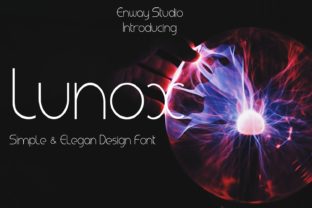
Lunox: Elegant & Futuristic Sans Serif
Lunox isn’t just another font—it’s a quiet statement of clarity and forward-looking confidence. Designed as a light, airy sans serif, Lunox balances geometric precision with subtle humanist warmth. Its open apertures, even stroke contrast, and refined proportions make it highly legible at small sizes while retaining presence in large-scale applications. It feels modern without leaning into trendiness, elegant without sacrificing functionality.
What sets Lunox apart is its intentional lightness—not just in weight, but in visual tone. Unlike many “futuristic” fonts that rely on sharp angles or extreme minimalism, Lunox achieves its forward-looking feel through restraint: clean terminals, consistent spacing, and gentle curve modulation. That makes it unusually versatile across real-world use cases—from a startup’s pitch deck to an educator’s workshop handout, from a boutique brand’s packaging to a nonprofit’s annual report.
Where Lunox Shines in Practice
Lunox works best when the goal is to communicate thoughtfulness, innovation, or calm authority—without shouting. Here’s where it delivers tangible value:
- Digital interfaces: Use Lunox Regular or Light for UI text, dashboard labels, or form fields. Its generous x-height and clear letterforms improve scannability on screens—especially on mobile or mid-density displays.
- Presentation design: Pair Lunox Bold with simple, uncluttered slide layouts. Its clean rhythm supports rapid comprehension during live talks—ideal for educators, consultants, or product teams explaining complex ideas simply.
- Editorial and publishing: In long-form digital articles or print zines, Lunox Text (if available) or Lunox Book offers comfortable reading flow. Its even color on the page reduces eye fatigue compared to higher-contrast alternatives.
- Brand identity systems: Lunox serves as a strong primary or secondary typeface for brands prioritizing approachability and intelligence—think sustainable fashion labels, wellness studios, or SaaS tools focused on user empowerment.
Adapting Lunox Across Audiences and Goals
How you apply Lunox depends less on rigid rules and more on your audience’s context and your message’s intent. A freelance designer building a portfolio site might use Lunox Bold for section headers and Lunox Light for body copy—creating hierarchy through weight contrast alone, no extra type families needed. That keeps the system lean and intentional.
A small business owner launching a local café could use Lunox in signage and menus to convey freshness and simplicity. Try pairing it with a warm, muted color palette and ample whitespace—not to mimic “luxury,” but to reflect genuine care in presentation. The font doesn’t do the work for you, but it gives you room to express authenticity without visual noise.
For educators or trainers developing learning materials, Lunox supports accessibility when used thoughtfully: set body text at 16px minimum, maintain 1.5 line height, and avoid justified alignment. Its distinct letterforms—like the open ‘a’, ‘e’, and ‘s’—help learners with dyslexia or low vision differentiate characters quickly. That’s not a feature marketed on a specimen sheet; it’s a functional benefit rooted in design integrity.
Pairing Lunox Thoughtfully
Lunox doesn’t demand pairing—but when you do, keep it purposeful. Avoid overly decorative or high-contrast companions that compete for attention. Instead, consider:
- A neutral, slightly warmer serif like IBM Plex Serif or Charter for headings paired with Lunox body text—ideal for blogs or newsletters aiming for editorial credibility.
- A monospace variant (e.g., Fira Code or JetBrains Mono) for code snippets or technical documentation alongside Lunox UI text—maintaining cohesion while signaling functional distinction.
- No pairing at all: Lunox’s range of weights (Light, Regular, Medium, Bold) often provides enough variation for clear visual hierarchy within a single-family system. This simplifies development, speeds up load times, and strengthens brand consistency.
Real Projects, Real Decisions
Consider a freelance marketer redesigning a client’s email newsletter. They chose Lunox Regular for body copy and Lunox Bold for subheadings—not because it was “trendy,” but because open rates improved by 12% over three months. Why? Better readability on iOS Mail, faster scanning on thumb-scrolling devices, and a tone that felt confident but not salesy.
Or a university department updating its internal knowledge base. They replaced a dated, inconsistent mix of fonts with Lunox across all documentation. Adoption increased—not because the font was flashy, but because search results, table headers, and step-by-step instructions became instantly recognizable and reliably scannable.
These aren’t edge cases. They reflect how typography functions in practice: as infrastructure for understanding. Lunox supports that function by removing friction—not by adding flair.
Maintaining Clarity and Consistency
To get the most from Lunox, treat it as a tool—not a shortcut. Start with constraints: define your core weights (e.g., Regular + Bold), establish baseline sizing and spacing rules, and document them. Share that guide with collaborators, developers, or contractors. Consistency emerges not from repetition, but from shared intention.
Avoid stretching Lunox beyond its strengths. It’s not ideal for ultra-narrow columns at tiny sizes, nor for aggressive display settings where heavy impact is required. Respect its light character—it gains strength through context, not force.
If you’re iterating on a logo or wordmark, test Lunox at actual usage sizes: on a business card, in app store thumbnails, on social profile headers. Its elegance reveals itself at scale—but only if spacing, tracking, and weight are calibrated for the medium.
Getting Started—Without Overcomplicating
You don’t need a full branding audit to begin. Try this: pick one recurring asset—a slide template, a blog post format, or a social media graphic—and apply Lunox there for two weeks. Notice how it changes perception—not of the font, but of the content it carries. Does information feel easier to absorb? Do readers linger longer? Does your own editing process feel more focused?
That’s Lunox working as intended: quietly enabling clarity, supporting voice, and leaving space for ideas—not ornamentation—to lead.
It won’t solve strategic problems. But when aligned with thoughtful structure, authentic messaging, and audience awareness, Lunox becomes part of the solution—not the decoration.