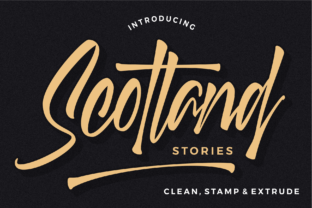
Scotland Stories: A Handwritten Font with a Bold Twist
Scotland Stories isn’t just another decorative typeface. It’s a deliberate design choice — one that carries weight, warmth, and unmistakable presence. Built on the organic rhythm of handwriting but sharpened with intentional boldness, it bridges authenticity and authority. For professionals who rely on visual language to shape perception — whether launching a brand, designing a course, crafting a pitch deck, or publishing long-form content — Scotland Stories offers more than aesthetic appeal. It delivers strategic leverage when used with purpose.
Why Scotland Stories Stands Apart From Generic Handwriting Fonts
Most handwritten fonts lean heavily into whimsy, informality, or nostalgia. They’re often too light, too uneven, or too fragile for serious applications. Scotland Stories avoids those pitfalls. Its bold twist gives it structural confidence without sacrificing humanity. The letterforms retain natural variation — slight inconsistencies in stroke width, subtle flourishes at terminals — but they’re grounded in consistent rhythm and strong x-height. That balance makes it legible at scale, resilient in print and digital, and versatile across contexts where credibility matters.
This isn’t a font for filler text or background decoration. It’s a tool for emphasis, framing, and emotional anchoring — especially where you want to signal sincerity, craftsmanship, or personal investment. Think of it as the typographic equivalent of speaking directly to someone’s attention, not shouting over noise.
Where Scotland Stories Delivers Real Strategic Value
Used intentionally, Scotland Stories strengthens communication at key decision points:
- Brand positioning: When your offering is rooted in human insight — coaching, therapy, education, artisan goods — Scotland Stories signals that people, not algorithms or abstractions, are at the center. It works well in logos, hero headlines, or signature statements where you want warmth to coexist with clarity.
- Content framing: In long-form articles, reports, or educational materials, it can elevate pull quotes, section headers, or key takeaways. Its boldness draws the eye without demanding attention; its handwriting roots keep the tone grounded and approachable.
- Customer experience touchpoints: Email subject lines, welcome messages, or handwritten-style notes in digital onboarding flows benefit from its authentic charm. It subtly reinforces trust — not by mimicking pen-on-paper, but by evoking care in execution.
- Creative direction: Designers and marketers use it to establish tonal contrast within a broader typography system. Paired with a clean sans-serif (like Inter or Lato), Scotland Stories becomes the voice — while the supporting type handles function.
How to Use Scotland Stories Without Undermining Your Goals
Its power lies in restraint — not repetition. Overuse dilutes impact and risks visual fatigue. Consider these practical thresholds:
- Limit usage to one primary role per project: Either headline type, signature element, or branded accent — never all three simultaneously.
- Avoid body text: Even at larger sizes, its personality competes with readability over extended reading. Reserve it for short, high-impact phrases.
- Test contrast rigorously: Its boldness doesn’t guarantee legibility against busy backgrounds or low-resolution screens. Always preview in context — not just in design tools.
- Respect hierarchy: If your main heading uses Scotland Stories, subheadings should step back — typically with a neutral, highly legible typeface — so the distinction feels intentional, not chaotic.
One common misstep is applying Scotland Stories to anything perceived as “creative” by default — like social media graphics or workshop slides — without asking: What outcome does this serve? Does it reinforce a message about care, craft, or connection? Or does it simply add visual noise? Clarity of intent separates effective use from decorative drift.
Planning With Scotland Stories in Mind
Before licensing or implementing Scotland Stories, align it with your broader communication strategy:
- Define the core impression you want to leave: Is it “thoughtful,” “trusted,” “human-centered,” or “uniquely personal”? If Scotland Stories doesn’t advance that impression, pause and reconsider.
- Map where authenticity adds value — and where it might distract: A financial services dashboard benefits little from handwriting flair. But a therapist’s website homepage, or a teacher’s curriculum overview, may gain real resonance.
- Assess technical constraints: Confirm licensing covers your intended platforms — web, app, print, video — and check file formats (WOFF2 for web, OTF for desktop). Some versions include alternate glyphs or ligatures; test whether those enhance or complicate your workflow.
- Build in review checkpoints: After implementation, revisit usage after two weeks. Does it still feel aligned? Has it become background noise? Adjust before scaling across assets.
Risks of Using Scotland Stories Without Clear Context
Without grounding in goals or audience understanding, Scotland Stories can unintentionally undermine credibility. For example:
- In B2B enterprise software marketing, deploying it in a product demo video may confuse rather than connect — suggesting informality where buyers expect precision and reliability.
- On a government health initiative site, it could inadvertently diminish perceived authority if users associate handwriting with amateurism rather than empathy.
- When applied inconsistently — say, only in email headers but not in landing pages — it fragments brand recognition instead of reinforcing it.
These aren’t flaws in the font itself. They reflect gaps in planning — mistaking visual novelty for strategic fit. Scotland Stories demands context to shine. It rewards intentionality; it resists autopilot.
Long-Term Value: Beyond Aesthetic Trends
Trends come and go — but typography choices that support enduring values tend to outlast them. Scotland Stories endures because it serves a lasting need: the human desire to feel seen, understood, and addressed directly. That need hasn’t changed. What has changed is how saturated our environments are with generic, algorithmically optimized visuals. In that landscape, Scotland Stories becomes a quiet differentiator — not flashy, but memorable; not loud, but resonant.
Businesses that invest time refining how and where they deploy Scotland Stories — testing, iterating, aligning with voice and mission — build subtle but cumulative advantages. Customers begin to associate that distinctive bold-handwritten rhythm with consistency of tone. Teams develop shared understanding around when to reach for it — and when to hold back. Over time, it stops being “just a font” and starts functioning as part of your operational grammar.
Final Strategic Guidance
If you’re considering Scotland Stories, start small and think backward:
- Identify one high-stakes communication moment where warmth and strength must coexist — perhaps a welcome email sequence, a keynote slide title, or a brand manifesto statement.
- Write the exact phrase you’d set in Scotland Stories, then ask: Does this phrase carry enough weight to justify the visual emphasis? If not, revise the copy first — typography amplifies meaning, it doesn’t create it.
- Compare it side-by-side with your current type system. Does it deepen contrast meaningfully? Or does it clash without reason?
- Document your rationale. Not for aesthetics — for future decisions. When onboarding new team members or evaluating refreshes, that note becomes invaluable: “We use Scotland Stories here because it signals personal commitment at the moment users decide whether to engage further.”
Scotland Stories earns its place not through ubiquity, but through precision. It’s most powerful when chosen not because it looks interesting, but because it helps people understand — quickly and quietly — that what follows matters, and was made with care. That kind of alignment doesn’t happen by accident. It happens when you treat typography as a decision-making tool — not just a design detail.