Red Lipstick Font
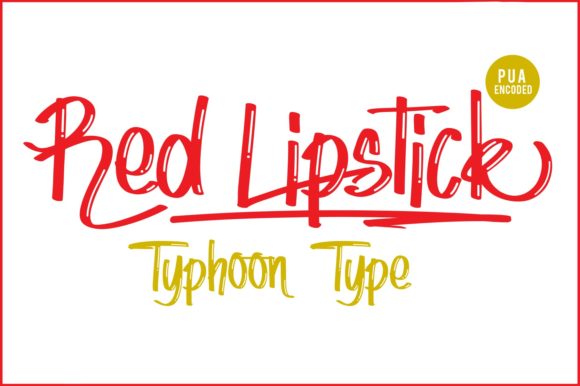
Red Lipstick is a handwritten display font characterized by its bold, expressive strokes and intentional roughness. Designed to evoke energy and personality, it features uneven baselines, irregular letterforms, and subtle texture—giving it the tactile feel of ink applied with confidence and spontaneity. It is not a script meant for formal correspondence or extended reading; rather, it functions as a visual accent, best suited for short, high-impact applications.
Why Consider Red Lipstick?
Designers and content creators often seek fonts that communicate attitude, authenticity, or creative flair without relying on imagery alone. Red Lipstick appeals in contexts where tone matters as much as message—such as event posters, social media graphics, product packaging for lifestyle brands, or editorial headlines aiming to stand out. Its name evokes immediacy and presence, and its visual execution delivers on that promise: it reads as both playful and assertive.
Interest in Red Lipstick typically arises when a project calls for human-centered expression—not polished perfection. Users evaluating this font often prioritize distinctiveness over neutrality and are comfortable with stylistic constraints in exchange for strong character.
Practical Benefits
- High visual recognition: Its irregular forms and weight distribution make it memorable at a glance, especially in digital environments where attention is fragmented.
- Strong tonal alignment: Works well for brands or campaigns centered on confidence, individuality, or unfiltered self-expression.
- Lightweight file size: As a single-weight, OpenType font, it loads efficiently and integrates smoothly into web and print workflows without complex licensing tiers.
- Consistent stylistic cohesion: Unlike multi-style families, Red Lipstick avoids internal inconsistencies—its roughness is deliberate and uniform across characters.
Key Tradeoffs and Limitations
Every display font carries functional boundaries, and Red Lipstick is no exception. Its design intentionally sacrifices legibility at small sizes and in dense text blocks. Letters like “a,” “e,” and “s” rely on context for interpretation, and spacing varies to support rhythm over uniformity—making it unsuitable for body copy, data labels, or accessibility-critical interfaces.
It also lacks language support beyond basic Latin characters (A–Z, numerals, common punctuation). Users working with multilingual content—especially those requiring accented characters, Cyrillic, or non-Latin scripts—will need supplemental typefaces. Additionally, because it is a single-weight, dynamic typographic hierarchy (e.g., pairing bold and light variants) isn’t possible within the family itself.
When Red Lipstick Fits Well
Red Lipstick performs strongest in controlled, intentional settings. Examples include:
- Short-form marketing assets—such as Instagram story headers, limited-edition product tags, or festival lineup announcements—where brevity and impact are primary goals.
- Branding elements for creative studios, indie publishers, or wellness brands emphasizing authenticity over corporate polish.
- Print collateral like concert posters or zine covers, where texture and tactility enhance physical engagement.
- Animated text overlays in video, where its irregularity translates well to motion and avoids sterile uniformity.
In these cases, its limitations become assets: constrained use reinforces focus, and its rough edge signals intentionality—not oversight.
When to Explore Alternatives
Consider other options if your project requires:
- Scalable readability: For responsive websites, app interfaces, or documents needing clear information hierarchy, a more versatile sans-serif or humanist serif (e.g., Inter, Lora, or Poppins) will serve broader usability needs.
- Multilingual support: If your audience spans multiple languages, fonts like Noto Sans, IBM Plex Sans, or Source Serif Pro offer wider character coverage without sacrificing quality.
- Typography-driven branding systems: Brands building comprehensive identity guidelines often benefit from families with optical sizes, multiple weights, and matching italics—capabilities Red Lipstick does not provide.
- Formal or institutional contexts: Legal notices, academic publications, or government communications generally prioritize neutrality and clarity over expressive distinction.
Making an Informed Choice
Evaluating Red Lipstick is less about whether it’s “good” and more about whether it aligns with your specific communication goals. Ask yourself:
- Is the message short, declarative, and benefitting from emotional resonance over neutrality?
- Will the font appear in contexts where size, contrast, and surrounding whitespace can support its legibility?
- Does the brand or project already embrace imperfection, movement, or handmade aesthetics—or would this font introduce dissonance?
- Are you prepared to pair it thoughtfully? Red Lipstick works best alongside clean, restrained supporting typefaces that ground its energy—avoid stacking it with other decorative fonts.
Testing is essential. Render sample text at intended sizes and backgrounds. Check contrast ratios for accessibility compliance if used digitally. Preview how it behaves across devices—especially on lower-resolution screens where fine texture may blur or disappear.
Final Considerations
Red Lipstick is a specialized tool, not a universal solution. Its value lies in precision: it excels when deployed with awareness of its boundaries. Designers who appreciate craft-based typography—and who understand that restraint often strengthens expression—tend to integrate it most effectively.
If your goal is differentiation through voice rather than decoration, and you’re willing to let the font guide usage rather than force it into unsuitable roles, Red Lipstick offers a compelling, grounded option. But if flexibility, scalability, or linguistic breadth are central requirements, investing time in evaluating broader font families will likely yield more sustainable results.