Boys Stuff: A Practical Dingbat Font for Visual Communication and Workflow Clarity
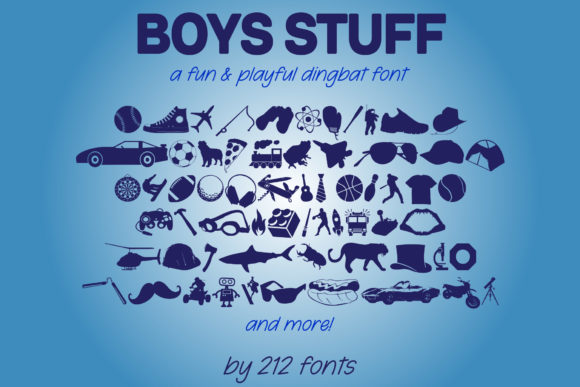
Boys Stuff is a playful yet purposeful dingbat font—98 hand-crafted silhouettes of objects kids love: wrenches, baseball gloves, fishing rods, hiking boots, sharks, tacos, camping lanterns, ladybugs, and more. It’s not decorative filler. It’s a visual shorthand tool designed to support clarity, speed, and consistency in communication—especially when words alone fall short or slow things down.
For professionals who plan, teach, build, sell, or create—whether designing a summer camp syllabus, prototyping a children’s app, labeling classroom supplies, or building a brand identity for a youth-focused product—Boys Stuff integrates where visual cues improve understanding faster than text. Its value isn’t in novelty; it’s in utility.
Where Boys Stuff Fits in Real Workflows
Unlike display fonts meant only for headlines or logos, Boys Stuff functions best as part of an active workflow—not as a final output, but as a supporting layer in planning, drafting, organizing, and presenting. Think of it like sticky notes with built-in meaning: you don’t use it to write an essay, but you might use it to label sections of a mood board, annotate a wireframe, or tag inventory categories in a shared spreadsheet.
It works before a project begins (e.g., sketching user journey maps for a kids’ educational app and using the fishing rod glyph to represent “exploration mode” or the backpack for “portable learning”). It supports execution (e.g., educators embedding the baseball glove next to “collaborative activity” in lesson plans, or marketers adding the shark icon beside “competitive analysis” in a pitch deck). And it aids review—like using the thermometer and campfire glyphs side-by-side to signal “temperature check + group reflection” during a team debrief.
Integration Without Friction
Boys Stuff is compatible with any application that supports OpenType fonts: Adobe Creative Cloud, Figma, Sketch, Canva, Google Docs (via add-ons), Microsoft PowerPoint, and even Notion via custom embeds or image uploads. No special plugins are needed—but consistency requires intention.
To avoid visual noise, limit usage to one or two glyphs per context. For example, in a workshop agenda, use only the hat for “role assignment,” the shoe for “movement-based activity,” and the bug for “observation task.” That’s three distinct, instantly recognizable signals—no legend required. Overuse dilutes meaning; restraint builds fluency.
Pair Boys Stuff with clean sans-serif typefaces (e.g., Inter, Helvetica, or Roboto) for body text. Avoid stacking it with other dingbats or overly stylized fonts—the strength of Boys Stuff lies in its simplicity and contrast against neutral typography.
Preparation Matters More Than You Think
Before dropping Boys Stuff into a document or design file, spend five minutes mapping your most common visual needs. What recurring concepts do you communicate? What terms get misinterpreted? What categories need instant recognition across teams or age groups?
Make a short list—e.g., “hands-on,” “group work,” “outdoor,” “review,” “choice,” “tool,” “safety,” “fun.” Then match each to a Boys Stuff glyph that feels intuitive *to your audience*, not just to you. The wrench may mean “tool” to a maker educator but “fix it” to a product manager. Align meaning early so usage stays consistent across documents, slides, and handouts.
Practical Use Cases Across Roles
Educators: Use Boys Stuff to scaffold instructions without increasing cognitive load. A science worksheet with the microscope, beaker, and ladybug icons beside steps signals equipment, procedure, and subject—before students read a word. In digital learning platforms, these glyphs serve as accessible visual anchors for neurodiverse learners and emerging readers.
Small Business Owners: If you run a mobile kids’ fitness class, embed the sneaker, water bottle, and stopwatch directly into your weekly email template. Parents scan quickly—these glyphs confirm gear requirements and timing at a glance, reducing no-shows and last-minute questions.
Freelance Designers & Marketers: When developing packaging or web copy for a new line of eco-friendly kids’ snacks, use the apple, leaf, and backpack glyphs in early mockups—not to finalize branding, but to test how well visual metaphors land with parent focus groups. Feedback on glyph relevance often reveals deeper assumptions about audience perception than text-only testing.
Productivity-Minded Hobbyists: Building a personal habit tracker for outdoor time? Replace generic checkboxes with the hiking boot, compass, and sun. The act of selecting and placing each glyph reinforces intention—and makes reviewing progress feel more tangible than a plain list.
Long-Term Usability Tips
Boys Stuff holds up over time because it avoids trend-driven styling. Its outlines are bold but neutral, scalable without distortion, and legible even at 12pt in print or on low-resolution screens. Still, longevity depends on how you maintain it.
- Store a master glyph reference sheet—a simple PDF grid with names and Unicode values—so anyone on your team can find and use the right symbol without guesswork.
- Document usage rules in your team’s style guide: e.g., “Only use Boys Stuff for category labels—not body copy,” or “Always pair with a 10px space before text.” Consistency compounds efficiency.
- Avoid converting glyphs to outlines unless necessary. Keeping them as live font characters preserves editability, searchability, and accessibility (screen readers can be trained to announce them meaningfully with proper ARIA labels in web contexts).
What Boys Stuff Doesn’t Do (and Why That’s Useful)
It doesn’t replace clear writing. It doesn’t automate decisions. It won’t fix inconsistent processes or unclear goals. And it’s not intended for formal publishing where typographic hierarchy must remain strictly textual.
That limitation is its strength. Because Boys Stuff doesn’t try to do everything, it excels where lightweight visual signaling adds real value: reducing ambiguity, accelerating scanning, reinforcing memory, and bridging language gaps. In a world saturated with dense interfaces and lengthy instructions, a single, well-placed shark or tent can do more work than three sentences.
Its practicality emerges not from how many glyphs it contains—but from how reliably each one lands the same meaning, across contexts, across time, and across people who didn’t sit in the same meeting.
Getting Started Tomorrow
You don’t need a big launch. Pick one recurring communication pain point this week—e.g., confusing step labels in a client onboarding checklist, or vague categories in a shared resource library. Identify two or three core ideas that need instant recognition. Download Boys Stuff. Assign one glyph to each idea. Test it in one live document. Ask a colleague or collaborator: “What does this icon mean to you?” Adjust if needed. Then repeat.
That’s how tools become workflows: not through overhaul, but through deliberate, repeated, small-scale integration. Boys Stuff fits there—not as a headline act, but as a quiet, reliable helper in the background of better-organized, more intuitive work.