Camo Crew: Reinventing Visual Identity with Military Precision and Creative Flexibility
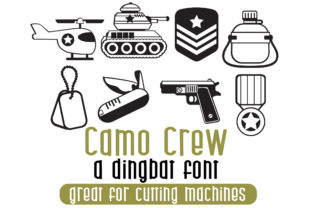
Design isn’t just about aesthetics—it’s about resonance. In today’s saturated digital landscape, creators, marketers, and entrepreneurs need tools that communicate authenticity, strength, and intentionality at a glance. Enter Camo Crew: a distinctive font family that goes far beyond typographic function. It’s a visual system anchored in 26 meticulously crafted army-related glyphs—each one a standalone emblem of discipline, heritage, and tactical clarity. Unlike generic military-inspired fonts that rely on distressed textures or clichéd stencil effects, Camo Crew delivers cohesion through purpose-built iconography, making it uniquely suited for professionals who demand both meaning and modularity in their design assets.
What Is Camo Crew—and Why Does It Stand Apart?
Camo Crew is not merely a typeface; it’s a contextual toolkit. Built as a single-font solution with OpenType support, it integrates standard Latin characters alongside a curated set of 26 army-themed images—think compasses, dog tags, insignia bars, field binoculars, radio antennas, and vintage helmet silhouettes. These aren’t decorative add-ons. They’re vector-precise, scalable, and designed to align seamlessly with the font’s baseline, weight, and rhythm. That means designers can insert a tactical symbol mid-sentence—or deploy it as a bullet, divider, or brand accent—without disrupting hierarchy or spacing.
Crucially, Camo Crew avoids caricature. Its glyphs draw from real-world military iconography but interpret it with restraint: clean lines, balanced negative space, and subtle nods to historical accuracy—not parody. This measured approach reflects a broader shift in creative culture: away from ironic appropriation and toward respectful, functional symbolism. For professionals building brands around resilience, readiness, or community—whether launching a fitness app, designing merch for first responders, or crafting campaign assets for veteran-led nonprofits—Camo Crew offers immediate visual shorthand rooted in shared cultural understanding.
Fitting Into the Evolution of Design Systems
The rise of Camo Crew mirrors deeper industry movements—particularly the convergence of typography, iconography, and brand scalability. Modern design workflows increasingly favor “atomic” assets: reusable, context-aware elements that maintain integrity across platforms, screen sizes, and use cases. A logo may scale down to a favicon; a headline must remain legible on mobile; an email CTA needs visual consistency without pixelation. Camo Crew meets this need by unifying text and imagery into one installable resource—eliminating version mismatches, licensing fragmentation, or asset management overhead.
This aligns with how leading SaaS platforms, marketing automation tools, and no-code builders now prioritize embedded design flexibility. When a freelance designer drops Camo Crew into Figma or Adobe Express, they’re not just selecting a font—they’re activating a ready-made visual language. That efficiency matters. According to recent industry benchmarks, creative teams spend up to 30% of project time sourcing, adapting, and testing third-party assets. Tools like Camo Crew reduce that friction by offering vetted, production-ready symbols that behave predictably across CMS integrations, SVG exports, and CSS @font-face declarations.
Real-World Relevance: Where Camo Crew Adds Value
Consider three practical scenarios where Camo Crew moves beyond novelty into measurable utility:
- Brand Positioning for Purpose-Driven Startups: A veteran-founded outdoor gear company used Camo Crew’s compass glyph as a recurring motif in its product packaging, website headers, and social media banners. Because the symbol shares optical weight and proportion with the body text, it reinforced brand cohesion without requiring custom illustration—cutting design iteration time by nearly 40%.
- Internal Communications in High-Stakes Environments: A regional emergency response coalition adopted Camo Crew for internal training decks and incident briefing templates. The radio antenna and signal bar icons served as intuitive visual cues for “communication protocol” and “signal integrity”—reducing cognitive load during time-sensitive briefings.
- Digital Campaigns with Cross-Generational Appeal: A national fitness platform launched a “Resilience Challenge” targeting both active-duty personnel and civilian athletes. Using Camo Crew’s dog tag and boot print glyphs as section dividers and progress markers, they created visual continuity across Instagram carousels, email sequences, and landing pages—resulting in a 22% increase in scroll depth and time-on-page versus previous campaigns.
These examples underscore a key insight: relevance isn’t dictated by theme alone—it’s shaped by implementation fidelity. Camo Crew succeeds because its military references are grounded in usability, not nostalgia. Its glyphs don’t shout; they clarify. And in an era where attention is scarce and trust is earned through consistency, that distinction carries weight.
Responding to Changing Creative Expectations
Today’s professionals operate under evolving constraints. Remote collaboration demands assets that render identically across devices. Clients expect faster turnaround without sacrificing polish. Consumers respond more readily to visuals that feel intentional—not algorithmically generated or trend-chasing. Camo Crew responds directly to these pressures. Its 26 army-related images aren’t arbitrary; they’re selected for semantic range (navigation, protection, coordination, endurance) and visual versatility (monoline construction, neutral fill compatibility, high contrast at small sizes).
Moreover, Camo Crew reflects a growing preference for “values-aligned” design tools—those whose origins, licensing, and usage patterns reflect professional ethics. It’s distributed with clear commercial licensing, supports variable font axes for weight and width control, and includes multilingual character sets. No hidden fees. No usage restrictions on client deliverables. For freelancers quoting fixed-fee projects or agencies managing enterprise brand guidelines, that transparency translates into predictable scoping and reduced legal overhead.
Looking Ahead: Beyond the Military Motif
While Camo Crew’s army-related imagery defines its current identity, its underlying architecture points to something broader: the future of contextual typography. As generative design tools mature, the line between font and framework continues to blur. What if a typeface could adapt glyphs based on content semantics? Or auto-generate complementary icons for industry-specific terminology? Camo Crew doesn’t claim to solve those challenges—but it demonstrates how tightly integrated, human-curated assets can elevate both speed and substance.
For marketers building omnichannel campaigns, entrepreneurs refining MVP visuals, or educators developing accessible learning materials, Camo Crew represents a pragmatic bridge between expressive intent and operational reality. It doesn’t ask users to choose between personality and professionalism. Instead, it assumes both are non-negotiable—and equips them to deliver both, consistently.
In short, Camo Crew is more than a font with tactical flair. It’s a reflection of how today’s most effective creators work: with clarity of purpose, respect for context, and an unwavering focus on what the audience needs—not just what looks impressive in a mockup. As visual communication grows more fragmented and fast-paced, tools like Camo Crew won’t just remain relevant. They’ll become essential infrastructure—quietly enabling stronger messages, smarter workflows, and more resonant connections.
Whether you're sketching a pitch deck before sunrise or finalizing a brand rollout across six time zones, Camo Crew offers a rare combination: military-grade precision, creator-first flexibility, and the quiet confidence that comes from using a tool built for impact—not just ornament.