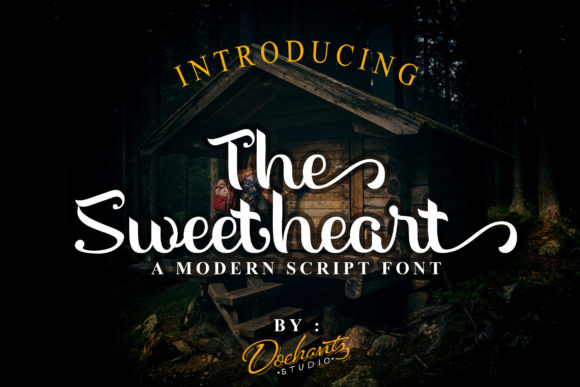
The Sweetheart
Imagine a font that whispers elegance while commanding attention — where flowing lowercase letters dance with the grounded authority of semi-blackletter capitals. That’s The Sweetheart: a modern script font engineered for designers who refuse to choose between personality and professionalism.
Why Typography Matters Beyond Aesthetics
In today’s saturated visual landscape, typography is rarely just decoration — it’s one of the most immediate carriers of brand voice, emotional tone, and cultural positioning. The Sweetheart stands out precisely because it bridges two powerful typographic traditions: the warmth and intimacy of hand-drawn script and the structural confidence of blackletter-inspired uppercase forms. This duality makes it unusually versatile across design contexts — from luxury packaging to digital interfaces — without sacrificing legibility or intent.
Strategic Applications Across Creative Disciplines
Whether you’re refining a brand identity system or crafting a single Instagram story, The Sweetheart delivers distinct advantages when applied thoughtfully:
- Logo design & branding: Its contrasting letterforms create built-in visual hierarchy — ideal for logotypes where the brand name needs both memorability and gravitas (e.g., “Luna & Co.” in lowercase script paired with “LUNA” in bold semi-blackletter).
- Social media graphics: Stands out in feeds without relying on heavy effects; works beautifully over textured backgrounds or soft gradients, especially when paired with a restrained color palette.
- Editorial and web design: Best used for headlines, pull quotes, or hero sections — never body copy — preserving readability while elevating visual storytelling.
- Packaging and print design: Adds tactile sophistication to artisanal goods, wedding stationery, boutique cosmetics, or limited-edition book covers where craft and intentionality are central to the experience.
It also performs well in UI elements like branded app splash screens or dashboard welcome messages — provided spacing, weight, and size are carefully calibrated. In UX design, subtle typographic contrast can guide attention more effectively than icons alone, and The Sweetheart’s expressive character supports that goal when used sparingly and intentionally.
Using The Sweetheart Responsibly
Like any expressive typeface, its impact depends entirely on context and execution. Here are three practical considerations before integrating it into your next project:
- Match tone to audience: While elegant, The Sweetheart leans toward refined, timeless, or artisanal — not tech-forward, minimalist, or aggressively youthful. Use it where warmth, craftsmanship, or narrative depth aligns with user expectations.
- Maintain consistency in hierarchy: Pair it with a clean, neutral sans-serif (e.g., Inter, Poppins, or Neue Haas Grotesk) for supporting text. Avoid competing scripts or overly decorative companions that dilute its uniqueness.
- Test scalability early: At small sizes (under 18px), the fine strokes of the lowercase may lose clarity — reserve it for larger applications unless you’re using a specially optimized version for screen use.
Color plays a critical supporting role: deep navy, charcoal, or muted terracotta enhances its classic sensibility, while crisp white or soft ivory maximizes contrast on dark backgrounds. Avoid overly saturated hues that compete with its organic flow — let the type breathe.
For marketers and business owners, selecting a font like The Sweetheart isn’t about trend-chasing — it’s about investing in a consistent, emotionally resonant layer of communication. Every time a customer sees your logo, reads your newsletter headline, or unboxes your product, typography shapes their subconscious perception of quality, care, and authenticity. In visual design, those impressions compound — quietly, powerfully — over time.
Ultimately, great creative assets don’t just look good; they serve a purpose, reinforce strategy, and deepen connection. When chosen with intention and applied with discipline, The Sweetheart becomes more than a font — it becomes part of your brand’s visual vocabulary, lending distinction to every touchpoint without ever shouting for attention.