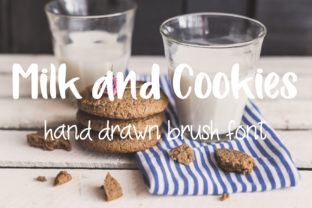
Milk and Cookies: A Handwritten Font That Feels Like Home
There’s something instantly disarming about a font that looks like it was scribbled with care—like notes passed in class, love letters tucked into lunchboxes, or recipe cards stained with vanilla extract. Milk and Cookies does exactly that. It’s not just another handwritten typeface. It’s warm, approachable, and quietly confident—a modern take on nostalgia that works as beautifully on a wedding invitation as it does on a Shopify product banner.
What Makes Milk and Cookies Stand Out?
At first glance, Milk and Cookies appears effortlessly simple. But simplicity—when done well—is the hardest thing to pull off. This font balances irregularity with intentionality: letterforms have gentle inconsistencies (a slightly tilted ‘o’, a tapered ‘t’ stroke), yet every glyph feels cohesive and purposeful. There’s no forced quirkiness—no exaggerated loops or chaotic swashes that distract from readability. Instead, it offers simple elegance: soft curves, open counters, and generous spacing that invites the eye to linger—not rush.
Unlike many handwritten fonts that lean heavily into either “childlike” or “artsy calligraphic,” Milk and Cookies lives comfortably in the middle. It’s friendly without being cutesy. Playful without sacrificing polish. That duality makes it unusually versatile—especially for creators who need personality *and* professionalism in one package.
Designed for Real-World Use
Good fonts aren’t just pretty—they’re functional. And Milk and Cookies was built with real workflows in mind:
- Web-safe rendering: Optimized for crisp display across devices, including mobile screens and retina displays—no fuzzy edges or inconsistent weight shifts.
- OpenType features: Includes ligatures, stylistic alternates, and contextual substitutions that add subtle variation when typing longer passages—so your “the” doesn’t look identical every time.
- Cross-platform compatibility: Works seamlessly in Figma, Adobe Creative Cloud, Canva, and even Google Fonts (via self-hosted embedding), making it easy to move between design tools and development environments.
This isn’t a font you’ll admire once and forget. It’s one you’ll reach for again and again—whether you’re designing an Instagram story for a local bakery, mocking up packaging for an organic tea brand, or drafting a heartfelt email newsletter.
Where Milk and Cookies Fits Best (and Where It Doesn’t)
Like any thoughtful tool, Milk and Cookies shines brightest in contexts where tone matters as much as typography. Here’s where it truly sings:
Branding with Heart
Small businesses, especially those rooted in craft, wellness, food, or education, often struggle to convey authenticity through type alone. Generic sans-serifs can feel sterile; overly ornate scripts can feel inaccessible. Milk and Cookies bridges that gap. Imagine it on a ceramic mug label (“Hand-thrown • Small-batch • Made with love”), or as the logo for a Montessori preschool. It signals warmth, attention to detail, and human-centered values—without saying a word.
Digital Touchpoints That Feel Personal
We scroll fast—but we pause for sincerity. In email marketing, Milk and Cookies used sparingly in headlines or CTA buttons adds emotional texture. Pair it with a clean, neutral sans-serif (like Inter or Poppins) for body text, and you create visual rhythm: playful energy up top, grounded clarity below. It’s also a favorite among Notion template designers, where users want dashboards that feel curated—not corporate.
Print That Invites Connection
Wedding stationery, baby shower invites, artisanal product tags—these are moments people hold, reread, and save. Milk and Cookies translates beautifully to print: its ink-trap–friendly outlines prevent filling-in during offset printing, and its moderate x-height ensures legibility even at 10pt in fine-print details.
That said, it’s not ideal for every use case. Avoid it for long-form editorial content (think blog posts or whitepapers), legal disclaimers, or interfaces requiring high scannability (like airport signage or medical device labels). Its charm lies in contrast—not continuity.
How to Use Milk and Cookies Thoughtfully
Even the most delightful font can fall flat without smart application. Here’s how to get the most out of Milk and Cookies:
- Lead with contrast. Never pair it with another handwritten or script font. Let it be the voice; everything else should play support. Try it with geometric sans-serifs (like Helvetica Now), humanist types (like Lora), or even monospaced fonts for unexpected tension.
- Respect hierarchy. Use it for headings, quotes, logos, or short calls-to-action—not paragraph text. If you’re using it in a logo, test it at multiple sizes: does it retain character at 24px? At 200px? At thumbnail scale?
- Embrace whitespace. This font breathes best when given room. Tight tracking or cramped line height muffles its charm. Aim for 1.4–1.6 line height in digital use, and generous margins in print layouts.
- Test color carefully. While it looks lovely in deep navy or charcoal, avoid very light grays or pastels on white backgrounds—they reduce contrast and soften impact. For accessibility, ensure text meets WCAG AA contrast ratios (4.5:1 minimum).
Why Designers Keep Coming Back to Milk and Cookies
It’s rare for a font to feel both timeless and timely—but Milk and Cookies manages it. Its appeal isn’t trend-driven; it’s rooted in something deeper: our shared love of the handmade, the personal, the unhurried. In an age of AI-generated content and algorithmic feeds, choosing a font like this is a quiet act of intentionality.
Designers tell us they reach for Milk and Cookies when they want to signal: This matters. You matter. We made this with care. It shows up in rebranding projects where legacy brands seek renewed warmth. It anchors mood boards for lifestyle brands launching their first physical product. It even appears in UI animations—subtle hover effects where letters “wobble” just enough to feel alive.
And because it’s lightweight (under 40KB as a WOFF2 file), it doesn’t slow down sites. Because it supports Latin-based languages (including extended diacritics), it scales gracefully across English, Spanish, French, and Portuguese markets. Because it includes both uppercase and lowercase, numbers, punctuation, and multilingual symbols, it avoids last-minute font-switching headaches.
A Font That Grows With You
Whether you're a solo creator building your first online shop, a marketing manager refreshing a seasonal campaign, or a designer crafting a client’s brand identity, Milk and Cookies adapts without demanding reinvention. It doesn’t shout. It doesn’t overpromise. It simply shows up—consistent, kind, and full of quiet confidence.
Fall in love with its simple elegance—not because it’s perfect, but because it feels true. Because it reminds us that behind every pixel, every package, every invitation, there’s a person reaching out. And sometimes, the most powerful message isn’t in what you say—but how warmly you say it.