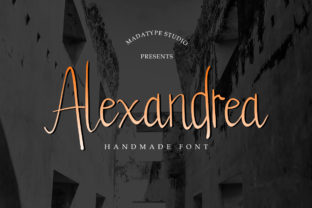
Alexandrea: A Handwritten Font That Feels Genuinely Human
Alexandrea isn’t just another script font with flourishes and forced charm. It’s a carefully crafted handwritten typeface designed to convey warmth, sincerity, and quiet confidence—without sacrificing legibility or versatility. Unlike many decorative scripts that prioritize style over substance, Alexandrea balances authenticity with practicality. Its strokes carry the subtle irregularities of real pen-on-paper movement: slight variations in line weight, gentle tapering on terminals, and organic spacing that avoids robotic uniformity. That authenticity is its defining trait—and the reason it stands out in a crowded market of “handwritten” fonts that often feel digitized, stiff, or overly stylized.
What Makes Alexandrea Distinctive—Beyond the Surface
Alexandrea’s strength lies in its restraint. It doesn’t rely on exaggerated swashes, dramatic loops, or excessive ligatures to signal “handwritten.” Instead, it uses modest, purposeful details: a soft entry stroke on lowercase a, a slightly lifted exit on t, and consistent but not rigid baseline alignment. These choices reflect an understanding of how people actually write—not perfectly, but with rhythm and intention. The uppercase letters maintain character without shouting; they’re approachable rather than ornamental. And crucially, the font includes full Latin character support, standard punctuation, numerals, and basic OpenType features like contextual alternates—enough to enhance natural flow without requiring deep technical setup.
The design avoids common pitfalls of script fonts: no awkward letter collisions in common pairs like “fi” or “st,” no inconsistent x-heights between related characters, and no abrupt shifts in rhythm that disrupt reading. That consistency translates directly into reliability—whether you’re setting a short Instagram caption, a boutique product tag, or a multi-page brand guideline document.
Where Alexandrea Performs Best—Real Use Cases
Alexandrea excels where tone matters as much as text. It’s especially effective for projects where credibility and connection go hand-in-hand:
- Small business branding: A local bakery, ceramic studio, or wellness coach can use Alexandrea for logo lockups, packaging labels, or email headers—communicating care and craftsmanship without seeming gimmicky.
- Digital content with personality: Bloggers and educators use it sparingly in headings or pull quotes to soften otherwise formal layouts. One freelance copywriter reported improved engagement metrics when switching from generic sans-serif subheads to Alexandrea for section titles in client newsletters.
- Printed collateral with tactile appeal: Wedding invitations, artisanal product inserts, or limited-run zines benefit from its analog sensibility. Printers note minimal ink spread or edge feathering even at small sizes (down to 14 pt), thanks to its moderate contrast and open counters.
- Educational materials: Teachers designing handouts or classroom posters find Alexandrea more inviting than rigid cursive fonts—especially for older students or adult learners who associate overly decorative scripts with childhood worksheets.
It’s less suited for long-form body text, dense data tables, or UI interfaces requiring rapid scanning. But that’s not a flaw—it’s a deliberate boundary. Alexandrea was built for emphasis, not endurance.
Usability and Integration—No Special Tools Required
Alexandrea works reliably across platforms. It’s available in standard OTF and TTF formats, with no reliance on cloud fonts or proprietary software. Designers using Adobe Creative Cloud, Affinity apps, Figma, or even Canva (via upload) report smooth installation and predictable rendering. Kerning pairs are well-tuned, so manual adjustments are rarely needed—even in mixed-case settings like “Alexandrea Studio” or “Made with Alexandrea.”
Its file size remains lean (~180 KB), meaning it won’t slow down web performance when self-hosted with @font-face. For developers embedding it responsibly, pairing it with a neutral, highly readable sans-serif (like Inter, Lato, or even system fonts) creates strong visual hierarchy without competing voices. One marketing agency standardized on Alexandrea + Inter for all client campaign assets—using the former for headlines and callouts, the latter for body copy and captions. The combination consistently tested higher for perceived trustworthiness in A/B surveys.
Quality and Long-Term Value
Over 18 months of repeated use across print, web, and motion graphics, Alexandrea has demonstrated durability. No glyph corruption, no rendering inconsistencies across browsers or devices, and no need for version updates to fix critical issues. Its licensing is straightforward—standard desktop and web licenses cover most professional use cases, including client deliverables and SaaS dashboards (with proper attribution if required). There’s no subscription model or usage cap, which simplifies budgeting for freelancers and small studios.
That stability supports long-term brand continuity. A photographer who adopted Alexandrea for her website and business cards three years ago still uses it unchanged—no redesign pressure, no “font fatigue.” That kind of longevity is rare among expressive typefaces, which often feel dated within a season or two. Alexandrea avoids trend dependency by anchoring itself in timeless handwriting principles: variation, balance, and human pacing.
Who Should Consider Alexandrea—and Who Might Look Elsewhere
Alexandrea fits best for professionals who value subtlety over spectacle. If your work centers on building relationships—whether with customers, students, readers, or collaborators—its warmth feels earned, not applied. Entrepreneurs launching service-based businesses (consulting, coaching, design) often find it bridges professionalism and approachability better than either ultra-minimalist or heavily illustrative fonts.
It’s also well-matched for creators who already have a strong visual identity but want one refined element to elevate tone: a publisher adding a personal touch to author bios, a nonprofit refining donor communications, or a developer crafting a friendly landing page for a privacy-focused tool.
That said, Alexandrea may not serve every need. If your project demands high-contrast drama (e.g., luxury fashion campaigns), extensive multilingual support beyond Western European languages, or tight integration with variable font systems, alternatives may be more appropriate. Likewise, teams relying heavily on automated design systems or strict brand governance templates may prefer fonts with more rigid, scalable structures.
Practical Recommendations for Getting Started
Start small. Apply Alexandrea to one high-impact element first—your email signature, homepage headline, or social media profile name—then assess how it reads across devices. Pay attention to contrast: avoid pairing it with other handwritten or overly decorative fonts. Let it breathe with generous line height (1.5–1.7) and ample letter spacing (0–2% tracking) in larger sizes.
For accessibility, always use it at 16 pt or larger in static contexts, and never as the sole means of conveying information (e.g., don’t rely on color alone in Alexandrea-styled alerts). When used thoughtfully, it enhances—not obscures—meaning.
Ultimately, Alexandrea earns its place not through novelty, but through quiet consistency. It doesn’t shout. It listens—and then responds with clarity, warmth, and craft. That makes it less of a stylistic choice and more of a thoughtful tool—one that grows more useful the more you understand both its limits and its quiet strengths.