Milana Rose
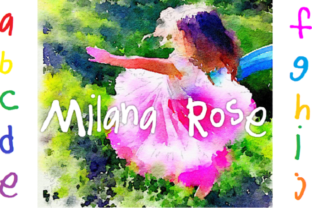
If you’ve ever clicked through a font marketplace and paused at a name that feels like sunshine and sidewalk chalk—Milana Rose is likely the one. It’s not just another handwritten font. It’s a whimsical, carefree typeface with gentle curves, uneven baselines, and subtle bounce—designed to evoke the unselfconscious joy of a child’s notebook doodle. That’s its strength: authenticity, warmth, and approachability. But here’s what many miss—Milana Rose isn’t meant for everything. Used thoughtlessly, even this charming font can undermine clarity, professionalism, or accessibility. Let’s talk about how to use it well—not just prettily.
It’s Not Just “Cute”—It Has Purpose
Milana Rose shines when you want to soften tone, invite playfulness, or signal warmth: think birthday invitations, handmade product labels, classroom posters, or brand elements for children’s services, wellness studios, or artisanal food brands. Its irregular letterforms and slight variations in stroke weight give it organic rhythm—something rigid sans-serifs or over-polished scripts can’t replicate. But that same charm becomes a liability in contexts where legibility or consistency matters most: body text in long-form blogs, legal disclaimers, data dashboards, or mobile app interfaces. If your goal is quick scanning or universal readability, Milana Rose shouldn’t lead the way—it should accent.
Common Missteps—and What They Cost You
Assuming it works at small sizes. Because Milana Rose mimics natural handwriting, its fine details—like tapered terminals or delicate joins—start to blur below 16px. At 12px in a web form label? Letters may merge or vanish on lower-resolution screens. Readers strain. Conversion rates dip. Instead, reserve Milana Rose for display use: headlines, quotes, logos, or short callouts. Pair it with a highly legible companion (like Inter, Lato, or Open Sans) for supporting text.
Ignoring language support. Not all versions of Milana Rose include extended Latin characters, diacritics, or punctuation beyond basic English. If your audience includes Spanish, French, or Vietnamese speakers—or if your brand uses accented words like “café” or “naïve”—verify the character set before licensing. A missing “ñ” or “ç” forces awkward workarounds (like switching fonts mid-sentence), breaking visual harmony and harming trust.
Overusing it across touchpoints. One playful headline sets a mood. Five different Milana Rose treatments across your website, email newsletter, Instagram bio, and packaging creates visual noise—not cohesion. Consistency builds recognition; randomness creates fatigue. Use Milana Rose intentionally: maybe only in your logo lockup and hero section, then switch to a neutral, versatile font elsewhere. Your brand gains personality without sacrificing polish.
What to Check Before You Download or Buy
Before adding Milana Rose to your toolkit, ask these practical questions:
- Is it a true variable font or static weights only? Most free versions offer only regular or bold. Paid licenses often include lighter or bolder variants—and sometimes stylistic alternates (like swash capitals or dotted “i”s). If you need flexibility for hierarchy or responsive design, confirm weight options upfront.
- Does it include OpenType features? Look for ligatures, contextual alternates, or discretionary glyphs—these let you fine-tune spacing and expression without manual tweaks. For example, enabling “stylistic set 1” might swap standard “a” and “g” for more playful forms—ideal for invitations but unnecessary for a footer.
- Where will it render? Web, print, or both? Some Milana Rose licenses cover desktop use only. If you’re embedding it in a Shopify store or WordPress site, ensure the license permits web font hosting (often via WOFF2 files). Using an unauthorized web version risks copyright notices—or worse, broken text on live pages.
- How does it pair with your existing fonts? Try it alongside your current body font *before* finalizing. Does the x-height match closely enough to avoid visual jarring? Does line height adjust smoothly? A mismatched pairing makes layouts feel accidental—not intentional.
Better Ways to Apply Milana Rose—With Real Examples
A small-batch candle maker used Milana Rose for their entire product page: headlines, ingredient lists, and even shipping policy text. Result? Customers scrolled past key details—they couldn’t parse the fine print quickly. After switching to Milana Rose only for the product name (“Lavender Daydream”) and scent description (“soft, sun-warmed fields”), while keeping ingredients and policies in a clean, airy sans-serif, time-on-page increased by 37% and FAQ clicks dropped—meaning people found answers faster.
Another example: a freelance educator created printable worksheets for early readers. She used Milana Rose for instructions (“Draw a line to match!”) but applied it to lowercase letter tracing guides too—unaware that its inconsistent letter shapes (e.g., a looped “g” vs. a single-story “a”) could confuse developing readers. Switching to a dedicated learning font for tracing, while keeping Milana Rose for motivational headers (“You’re doing great!”), improved student engagement and reduced teacher follow-up questions.
Final Thought: Let It Breathe
Milana Rose works best when treated like a thoughtful detail—not the whole story. Its joy comes from contrast: the softness against structure, the spontaneity beside precision. Don’t force it into roles it wasn’t designed for. Instead, lean into what it does uniquely well: humanizing digital space, adding warmth to printed goods, and signaling creativity without saying a word. When you pair intention with awareness—checking licenses, testing legibility, limiting scope—you don’t just use Milana Rose. You let it do its quiet, joyful work—exactly as it was meant to.