Doodletoon: Where Playful Typography Meets Purposeful Design
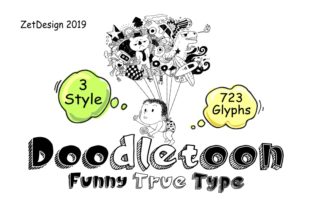
Typography is rarely neutral—it carries tone, signals intent, and quietly shapes how information is received. Among the thousands of sans serif fonts available today, Doodletoon stands apart not by technical precision alone, but by its deliberate embrace of imperfection, rhythm, and human gesture. It’s a comic-style sans serif font with a unique feel—neither rigidly geometric nor loosely handwritten, but something in between: structured enough for clarity, expressive enough to invite attention.
A Font That Breathes Like a Sketch
At first glance, Doodletoon evokes the spontaneity of a quick sketch—slightly uneven baselines, subtle variations in stroke weight, rounded terminals that soften sharp angles, and letterforms that tilt just enough to suggest motion. Yet this isn’t randomness disguised as design. Every glyph has been carefully crafted to maintain legibility across sizes and contexts. The “a” features a single-story construction reminiscent of casual handwriting; the “g” leans into a playful double-loop form; even punctuation marks—like the gently curved quotation marks or the slightly off-center period—reinforce its hand-drawn sensibility without sacrificing function.
This balance makes Doodletoon especially effective where warmth and approachability matter: educational materials for younger learners, community-driven initiatives, creative workshops, or brand identities seeking authenticity over polish. Unlike fonts designed for corporate annual reports or legal disclaimers, Doodletoon doesn’t aim to disappear—it invites engagement. Its presence is part of the message.
Who Finds Value in This Kind of Type?
Doodletoon resonates across diverse roles—not because it’s universally appropriate, but because it solves specific communication challenges in distinct ways.
- Educators use it in classroom posters, illustrated lesson summaries, and student-facing worksheets. Its friendly proportions and open counters improve readability for emerging readers, while its visual personality helps anchor abstract concepts—think of a Doodletoon-labeled diagram of the water cycle or a vocabulary chart where each word appears inside a softly outlined speech bubble.
- Small business owners, particularly those in creative services (bakers, craft studios, indie bookshops), integrate Doodletoon into signage, packaging, and social media graphics. It communicates care and individuality without requiring custom illustration—serving as both typography and subtle branding.
- UX designers and product teams occasionally deploy Doodletoon in onboarding flows or microcopy for apps targeting children, families, or wellness audiences. Its low visual stress supports comprehension during early-stage user interaction—especially when paired with high-contrast color schemes and generous spacing.
- Hobbyists and makers rely on it for zines, sticker sheets, and DIY greeting cards. Because Doodletoon includes extended Latin character support and basic diacritics, it works across English, Spanish, French, and German projects without fallback issues—making it practical for multilingual personal publishing.
Real-World Applications Beyond Aesthetics
Typography choices often reflect deeper design decisions about audience, context, and cognitive load. Doodletoon shines where traditional sans serifs fall short—not in formal documents or data dashboards, but in environments where emotional resonance supports functional goals.
Consider a local library launching a summer reading challenge. A flyer set entirely in Helvetica might convey professionalism—but could also feel distant. Switching key headings and call-to-action buttons to Doodletoon (while keeping body text in a highly legible companion like Open Sans) creates hierarchy through contrast: the playful font draws the eye, signals fun and participation, and subtly reassures children and caregivers alike that this initiative is inclusive and unintimidating.
Or imagine a mental health nonprofit producing printable mindfulness exercises. Here, Doodletoon’s gentle curves and irregular rhythm mirror the non-linear, compassionate nature of self-care practice. Using it for section titles (“Breathe In,” “Notice Without Judging,” “Draw How You Feel”) reinforces intentionality—not as instruction, but as invitation.
In both cases, Doodletoon isn’t decorative filler. It functions as a visual cue that primes interpretation before a single word is read.
Technical Considerations for Practical Use
Like any specialized typeface, Doodletoon performs best when matched thoughtfully to its environment. It ships in standard OpenType format with both regular and bold weights—no italic variants, which is intentional. Its design philosophy favors clarity over stylistic flourish, so slanting would compromise its structural integrity. Users who need emphasis typically pair bold Doodletoon headings with a clean, neutral sans serif for supporting text—a pairing that enhances contrast without competing voices.
Web performance is another practical factor. At under 60 KB for the full family (WOFF2), Doodletoon loads efficiently, especially when served via modern CDNs or self-hosted with proper subsetting. For print-heavy workflows, embedding Doodletoon in PDFs poses no compatibility issues—it renders consistently across Adobe Acrobat, Preview, and most professional RIPs.
One common oversight? Overuse. Because Doodletoon carries such strong personality, setting entire paragraphs in it—even at 14px—can fatigue readers. Best practice: reserve it for headlines, labels, pull quotes, and interactive elements. Let it punctuate, not dominate.
How Doodletoon Fits Into Broader Design Trends
The rise of Doodletoon aligns with several observable shifts in visual communication:
- Human-first interfaces: As AI-generated content grows more pervasive, audiences increasingly value artifacts that signal human origin—whether through texture, asymmetry, or idiosyncratic detail. Doodletoon delivers that signal typographically.
- Contextual typography: Designers are moving away from “one font fits all” systems toward purpose-built type hierarchies. Doodletoon fills a niche many systems lack: a friendly, scalable sans serif optimized for engagement—not efficiency.
- Educational accessibility evolution: Research continues to affirm that varied typographic treatments support multimodal learning. Fonts with distinctive letterforms (like Doodletoon’s lowercase “l” versus uppercase “I”) reduce confusion for dyslexic readers and young learners—without needing specialized dyslexia fonts in every case.
Importantly, Doodletoon doesn’t reject digital precision—it reinterprets it. Its metrics are rigorously tested for line-height consistency, kerning pairs adjusted for optical balance, and hinting optimized for screen rendering at 16–24px. This engineering ensures it behaves predictably, even as it looks delightfully unpolished.
When to Choose Doodletoon—and When to Pause
Doodletoon excels when your goal is to lower barriers to engagement. It’s ideal for:
- Projects targeting children ages 4–12
- Community outreach materials (neighborhood newsletters, event posters)
- Creative prompts and workshop handouts
- Brands rooted in craft, play, or storytelling
- Infographics where visual tone must match narrative warmth
It’s less suited for:
- Legal, financial, or medical documentation requiring absolute neutrality
- High-density data tables or code documentation
- Brands built on austerity, luxury minimalism, or technological authority
- Long-form editorial content (e.g., magazine articles or white papers)
This isn’t a limitation—it’s fidelity to intent. Doodletoon was never meant to replace Inter or Roboto. It exists to complement them, offering a different kind of clarity: one rooted in empathy rather than uniformity.
Integrating Doodletoon Thoughtfully
Implementation begins with intention—not installation. Before loading the font file, ask: What emotion or action should this text evoke? If the answer is “trust through familiarity,” Doodletoon may be perfect. If it’s “authority through restraint,” another option likely serves better.
For web developers, CSS variable setup simplifies consistent usage:
@font-face {
  font-family: 'Doodletoon';
  src: url('doodletoon-regular.woff2') format('woff2');
  font-weight: 400;
  font-display: swap;
}
Pairing suggestions enhance versatility. Try Doodletoon Bold for headings with Source Sans Pro or IBM Plex Sans for body copy—both offer excellent readability and share Doodletoon’s humanist proportions without visual conflict. For print, consider using Doodletoon alongside Quicksand or Nunito in supporting roles—they share its rounded warmth but offer greater typographic range.
And remember: testing matters. View Doodletoon on multiple devices, at varying zoom levels, and in real lighting conditions—not just in design tools. Its charm lies partly in how it responds to context: slightly bolder under fluorescent light, softer on matte paper, more animated on vibrant backgrounds.
Typography as Quiet Advocacy
In an era of algorithmically generated visuals and templated layouts, choosing a font like Doodletoon is a small but meaningful act of advocacy—for humanity in design, for variation in voice, for the idea that clarity doesn’t require sterility. It reminds us that even the most functional tools carry values: Doodletoon values curiosity over conformity, connection over control, and expression that emerges from structure—not despite it.
Its whimsical twist isn’t frivolous. It’s functional. It’s empathetic. And when used with awareness, it transforms how people see, process, and respond to information—not because it shouts, but because it listens first.