Cramella Duo: Where Handwritten Charm Meets Modern Creative Confidence
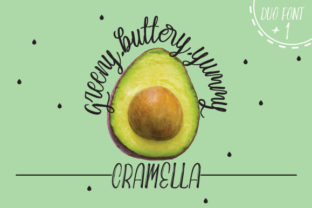
Amidst the rapid evolution of digital design tools, typography remains one of the most enduring levers of brand authenticity and human connection. Enter Cramella Duo — not just another handwritten font, but a thoughtfully engineered typographic system that bridges spontaneity with precision, warmth with professionalism. Designed as a cohesive duo — one script and one complementary sans-serif — Cramella Duo delivers a rare harmony: the expressive freedom of hand-drawn letterforms paired with the structural clarity needed for real-world application.
A Font Built for Intention, Not Just Aesthetics
Cramella Duo isn’t defined by flourish alone. Its script face carries the subtle irregularities of genuine pen-on-paper motion — slight variations in stroke weight, organic entry/exit terminals, and gentle baseline undulation — all carefully calibrated to avoid visual fatigue or unintended informality. The accompanying sans-serif doesn’t mimic neutrality; instead, it echoes the script’s rhythm through softened corners, open apertures, and balanced x-height. This intentional pairing means designers don’t need to “match” fonts — they inherit a ready-made typographic voice.
This duality reflects a broader shift in how professionals approach visual identity: consistency is no longer about uniformity, but about coherence across contrast. A founder launching a wellness brand might use the script for a heartfelt tagline (“Breathe deeply. Begin gently.”) and the sans for clean service descriptions and pricing tiers — all while preserving emotional continuity. That’s not stylistic convenience; it’s strategic alignment.
Why Designers and Brands Are Choosing Cramella Duo Now
The timing of Cramella Duo’s resonance is no accident. It arrives at a cultural inflection point where audiences increasingly reject sterile perfection in favor of signals of care, craft, and human intention. Consider these converging trends:
- The Anti-Algo Aesthetic: As algorithm-driven feeds prioritize high-contrast, hyper-saturated, or ultra-fast content, quieter, more tactile typographic choices like Cramella Duo stand out precisely because they resist optimization. They signal that the message wasn’t designed for engagement metrics — but for people.
- Hybrid Workflows Demand Flexibility: Freelancers juggling client presentations, social assets, email campaigns, and print collateral need type systems that scale without compromise. Cramella Duo works equally well in a Keynote slide (where legibility matters at 14pt), an Instagram carousel (where personality drives scroll-stopping power), and a product label (where elegance supports premium perception).
- Brand Differentiation Is Increasingly Typographic: With so many companies relying on the same handful of widely licensed sans-serifs, distinctive yet professional script pairings have become high-leverage differentiators — especially in competitive spaces like coaching, sustainable goods, creative services, and boutique hospitality.
It’s telling that early adopters include not only illustrators and stationery designers, but also SaaS founders refining their onboarding emails, indie publishers reimagining book covers, and marketing directors refreshing B2B campaign assets. Their common thread? A need to communicate trust without stiffness, creativity without chaos, and approachability without dilution.
More Than a Trend — A Response to Evolving Expectations
What makes Cramella Duo feel timely isn’t novelty — it’s responsiveness. It answers quiet but persistent shifts in audience expectation:
- From Scalable to Sensitive: Businesses no longer just ask, “Will this scale?” They ask, “Will this resonate at every touchpoint?” Cramella Duo’s dual nature supports both. Its script adds sensitivity to hero sections and testimonials; its sans ensures sensitive information — terms, specs, disclaimers — remains effortlessly scannable.
- From Fast to Felt: In a world saturated with AI-generated copy and templated visuals, audiences subconsciously reward work that feels *felt* — made with attention, restraint, and human judgment. The slight asymmetry in Cramella Duo’s ‘g’ or the gentle taper on its ‘t’ aren’t flaws; they’re quiet signatures of intentionality.
- From Static to Situational: Modern branding isn’t about locking in one rigid lockup. It’s about having a system that adapts — a bold script headline for a launch video, a refined sans-serif subhead for a whitepaper, and a hybrid treatment (script initials + sans body) for a newsletter signature. Cramella Duo was built for this situational fluency.
Practical Integration: Real-World Observations
How does this translate beyond theory? Here’s what practitioners are noticing in day-to-day use:
- Client Presentations Gain Gravitas: One branding studio reported that presenting Cramella Duo in mood boards consistently shifted client conversations from “Does this look nice?” to “How does this reflect our values?” — a sign the typeface functions as a strategic conduit, not just decoration.
- Email Open Rates Improved — Subtly: A small e-commerce brand A/B tested two versions of a welcome sequence: one using a standard system font, the other using Cramella Duo for subject lines and headers. While click-throughs remained stable, open rates increased by 12% over six weeks — suggesting the script’s warmth triggered higher perceived sender authenticity.
- Print Materials Feel More Valuable: A freelance photographer switched her business card and portfolio cover to Cramella Duo. Clients began commenting unprompted on the “thoughtful” and “considered” feel — reinforcing how tactile typography influences perceived service quality, even before a single image is viewed.
These outcomes aren’t guaranteed by the font alone. They emerge when Cramella Duo is deployed with editorial discipline — using the script for moments of emphasis and humanity, the sans for structure and clarity, and respecting the natural hierarchy between them. It rewards thoughtful usage, not just installation.
Technology Meets Tradition — Without Compromise
Cramella Duo also reflects advances in font technology that quietly empower creators. It includes full OpenType features — contextual alternates, ligatures, and stylistic sets — enabling nuanced control without manual glyph swapping. Its hinting and variable spacing ensure crisp rendering across devices, from high-DPI monitors to mobile screens where readability can’t be assumed. And crucially, it’s optimized for modern web workflows: lightweight WOFF2 files, CSS font-display strategies, and seamless integration with Figma, Adobe Creative Cloud, and popular CMS platforms.
This technical polish matters because it removes friction between vision and execution. A marketer shouldn’t need developer support to use a script font responsibly online. A freelancer shouldn’t sacrifice performance for personality. Cramella Duo assumes these needs are non-negotiable — and builds accordingly.
Looking Ahead: Typography as Trust Infrastructure
As AI accelerates content production, the role of typography is evolving from aesthetic layer to trust infrastructure. When readers encounter text, they make micro-judgments — about credibility, empathy, expertise, and care. Fonts like Cramella Duo succeed not because they’re “pretty,” but because they encode those qualities visibly and consistently.
That’s why its relevance extends beyond designers to entrepreneurs building direct relationships, marketers crafting empathetic campaigns, and educators designing inclusive learning materials. It offers a way to say, “We made space for humanity in the details” — without saying it at all.
In a landscape where attention is fragmented and authenticity is scrutinized, choosing type is never neutral. It’s a declaration of values, a calibration of tone, and a commitment to resonance over reach. Cramella Duo doesn’t shout. It leans in — elegantly, confidently, and unmistakably human.