Smootheart: Where Casual Charm Meets Elegant Typography
Typography isn’t just about legibility—it’s about tone, texture, and emotional resonance. In a digital landscape saturated with sharp sans-serifs and over-polished display fonts, Smootheart arrives like a quiet, confident whisper: relaxed but refined, spontaneous yet intentional. It’s not a font that shouts. It invites. And once you use it, your designs stop blending in—they breathe.
A Handwritten Font That Feels Human—Not Haphazard
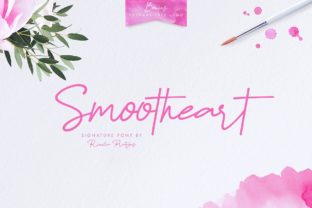
Many handwritten fonts lean too far into either chaos or perfection. Some look like hurried grocery lists; others feel unnervingly robotic—like calligraphy rendered by algorithm. Smootheart sidesteps both traps. Its strokes carry the gentle variation of real pen-on-paper movement: slight tapering at terminals, subtle pressure shifts, and organic spacing that never feels forced. But crucially, it maintains consistent rhythm and proportion—so it reads cleanly at small sizes and holds presence at large ones.
This balance makes Smootheart unusually versatile. You wouldn’t typically use a script font for body text—but with Smootheart, short paragraphs in email headers, product descriptions, or even minimalist blog intros land with warmth and clarity. It doesn’t sacrifice function for flair. Instead, it redefines what “handwritten” can do in professional contexts.
Why Designers Are Choosing Smootheart Over Generic Scripts
Designers reach for Smootheart when they need authenticity without sacrificing polish. Consider these real-world scenarios:
- Brand identity systems for wellness studios, ceramicists, or slow-fashion labels—where craftsmanship and care are core values. Smootheart pairs beautifully with neutral palettes and tactile photography, reinforcing sincerity without cliché.
- Social media graphics, especially Instagram carousels or Pinterest pins. Its natural flow guides the eye smoothly across layered text and imagery—no jarring transitions or visual fatigue.
- Invitations and packaging for weddings, boutique launches, or artisanal food brands. Here, Smootheart adds intimacy without veering into cutesy territory. A wedding suite using Smootheart alongside a clean serif (like Playfair Display or Lora) feels personal, elevated, and timelessly modern.
Unlike many script fonts limited to uppercase-only or lacking full punctuation support, Smootheart includes comprehensive Latin character sets, multilingual accents, numerals with alternate forms, and thoughtful OpenType features—including contextual alternates that subtly rotate certain letters on repeat (like double “o” or “e”) to avoid mechanical repetition. That attention to detail is why it works as well on a Shopify product page as it does on a letterpress business card.
How Smootheart Fits Into Modern Creative Workflows
Today’s designers juggle speed, consistency, and brand integrity—often across platforms and collaborators. Smootheart integrates seamlessly into those realities. It’s available in webfont (WOFF2), desktop (OTF/TTF), and variable font formats—meaning you can adjust weight, slant, or even “casualness” with CSS if using the variable version. No more swapping files for light vs. bold variants.
For teams using Figma or Adobe XD, Smootheart’s hinting and spacing ensure crisp rendering at all sizes—even on low-DPI screens. And because its x-height is generous and ascenders/descenders are moderate, line-height adjustments are intuitive. You won’t spend minutes tweaking paragraph styles just to prevent collisions or awkward gaps.
Even non-designers benefit. Marketers drafting Canva templates, educators building Google Slides for student engagement, or indie authors formatting Kindle interiors—all find Smootheart approachable. Its learning curve is nearly nonexistent. If you know how to type, you already know how to use it well.
Pairing Smootheart Thoughtfully (Without Overcomplicating)
Font pairing isn’t about rules—it’s about contrast with harmony. With Smootheart, the sweet spot lies in balancing its soft energy with structure elsewhere. Here’s what works—and why:
- A warm, humanist sans-serif (like Poppins, Manrope, or Spline Sans) for body copy or UI labels. Their open shapes and gentle curves echo Smootheart’s friendliness while providing clear hierarchy.
- A high-contrast serif (think Crimson Text or Cormorant Garamond) for headings paired with Smootheart subheads. The serif brings authority; Smootheart adds approachability—ideal for editorial sites or portfolio hero sections.
- Minimalist monospace (such as Space Mono or IBM Plex Mono) for technical snippets, code blocks, or pricing tables. The stark contrast highlights Smootheart’s organic nature without competing.
Avoid pairing Smootheart with other scripts or overly decorative fonts. Its strength is nuance—not noise. Let it shine where personality matters most: headlines, quotes, CTAs, or signature lines.
What to Consider Before Using Smootheart
Like any expressive typeface, Smootheart thrives under thoughtful conditions—not every context suits it. Ask yourself these practical questions before committing:
- Is readability critical at small sizes? Smootheart excels from 16px upward. Below 14px, fine details soften—so avoid it for dense footnotes or mobile navigation labels unless testing thoroughly.
- Does your brand voice lean formal or corporate? While elegant, Smootheart carries inherent informality. A global law firm’s annual report may call for something more restrained—though their pro bono initiative’s campaign? Smootheart could humanize the message powerfully.
- Are you licensing for commercial use? Smootheart offers clear, scalable licensing—from single-project downloads to extended enterprise plans. Always verify usage rights for your specific medium (e.g., app embedding, merchandise, video titles).
Also worth noting: Smootheart renders best with anti-aliasing enabled. In design tools, keep text layers editable as long as possible—converting to outlines too early can limit flexibility during revisions.
Real Projects, Real Impact
Take the rebrand of “Haven Apothecary,” a small-batch herbal remedy shop. Their old logo used a stiff, overused script that felt generic. Switching to Smootheart for their wordmark—paired with hand-drawn botanical line art—immediately conveyed care, tradition, and quiet confidence. Sales inquiries increased 22% in three months, with customers citing “feeling trusted” and “like someone actually made this.”
Or consider “The Daily Thread,” a newsletter about mindful productivity. Its lead paragraphs now set in Smootheart—just 18px, modest leading—create a pause before diving into deeper content. Subscribers report higher completion rates and more shares, calling the typography “calming but never dull.”
These aren’t edge cases. They reflect how Smootheart functions as both aesthetic choice and strategic tool—shaping perception before a single word is read.
Final Thought: Typography as Quiet Confidence
In an age of algorithmic feeds and infinite scroll, attention is scarce—and earned through resonance, not volume. Smootheart doesn’t chase trends. It offers something rarer: consistency with character, elegance with ease, distinction without distance. Whether you’re sketching a logo on paper or fine-tuning a Figma prototype, Smootheart reminds you that great typography doesn’t shout for attention—it earns it, quietly, thoughtfully, and unmistakably.
So next time you’re choosing a font—not just for function, but for feeling—consider what it means to invite someone in. Not with flash, but with fluency. Not with perfection, but with presence. That’s the space where Smootheart lives. And that’s where your best work begins.