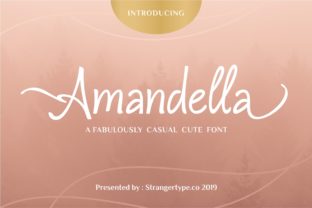
Amandella: A Casual Cute Font with Stylish Alternates
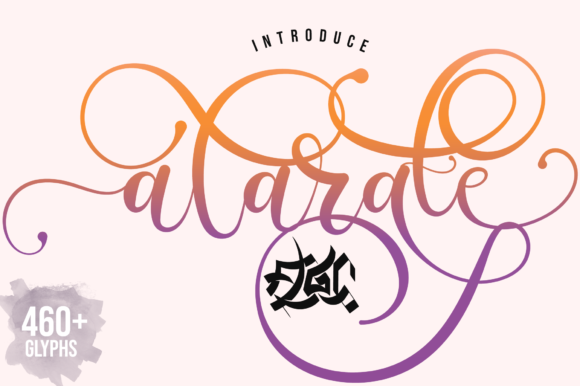
Amandella is a carefully crafted display font that balances approachability and visual interest. It’s not designed for body text or long-form reading—but rather for moments where tone, personality, and light decorative flair matter. Think of it as the kind of typeface you reach for when you want to signal warmth without sacrificing polish: a logo for a handmade ceramics studio, a headline for a lifestyle blog post about slow mornings, or a playful yet intentional tagline on a boutique skincare label.
What Sets Amandella Apart
At first glance, Amandella reads as friendly and relaxed—its rounded terminals, soft curves, and modest contrast give it an undeniably “casual cute” character. But what distinguishes it from generic rounded sans-serifs is its thoughtful system of stylistic alternates. Both uppercase and lowercase letters include multiple variants—some with subtle flourishes, others with shifted proportions or softened angles—that allow designers to fine-tune rhythm and expression without switching fonts.
For example, the alternate “a” might feature a lifted bowl and open counter; the “R” could swap its standard leg for a more calligraphic curve; the “W” may offer a version with slightly tapered arms. These aren’t gimmicks—they’re functional tools. Used selectively, they add nuance to short text blocks. Used consistently across a set, they support brand voice with quiet intentionality.
Practical Use Cases and Real-World Performance
Amandella performs best in controlled typographic environments: headlines up to ~48pt, short labels, social media banners, packaging accents, and editorial pull quotes. Its x-height is generous, aiding legibility at moderate sizes, but its letterfit and spacing are optimized for display—not dense paragraphs. In testing across digital and print contexts, it held up well on high-DPI screens and retained charm in spot-color screen printing.
We’ve seen it work effectively in several real projects:
- A freelance illustrator used Amandella for her portfolio site’s hero section—pairing the regular “A” with an alternate “m” and “d” to create a custom wordmark that felt hand-drawn but professionally refined.
- A small-batch candle brand applied Amandella to product tags alongside a neutral sans-serif (like Inter or Poppins) for ingredients and descriptions—creating clear visual hierarchy without visual dissonance.
- An educator designing workshop handouts chose Amandella for section headers, leveraging alternates to differentiate modules while keeping the overall layout cohesive and age-appropriate for adult learners.
In each case, the font supported—not overpowered—the message. Its strength lies in restraint: it adds character without demanding attention.
Quality and Technical Considerations
Amandella ships as a well-structured OpenType font with full Latin character coverage (including diacritics for Western European languages), standard ligatures, and contextual alternates activated via OpenType features. Kerning is tight and consistent across common letter pairs, and spacing feels balanced whether used in all-caps or mixed case. The design avoids over-engineered quirks—no forced swashes, no exaggerated distortions—so it integrates smoothly into existing workflows.
It’s compatible with major design tools (Adobe Creative Cloud, Figma, Affinity Suite) and supports variable font capabilities in newer versions, though the core release remains static. For users relying heavily on web typography, it’s worth noting that Amandella isn’t available on Google Fonts or Adobe Fonts by default—it’s typically licensed directly from the foundry or reputable marketplaces like Creative Market or MyFonts. That means embedding requires self-hosting or proper licensing for web use.
Who Benefits Most—and When to Pause
Amandella suits professionals who value both aesthetic control and typographic efficiency. Freelancers building brand identities for creative small businesses often find it especially useful: it delivers distinctiveness without requiring custom lettering. Marketers launching seasonal campaigns—say, a spring collection or holiday gift guide—appreciate how quickly it conveys mood through type alone. Bloggers and content creators targeting audiences that respond to authenticity and tactile sensibility (think food, wellness, craft, or education niches) report strong engagement when using Amandella for featured image text or newsletter headers.
That said, it’s not universally appropriate. Avoid Amandella for:
- Legal disclaimers or accessibility-critical interfaces—its decorative nature reduces functional clarity at small sizes.
- Brands built on authority, precision, or technical rigor (e.g., fintech dashboards, academic journals, engineering firms).
- Projects requiring multilingual support beyond Latin-based scripts—no Cyrillic, Greek, or extended Asian language sets are included.
Also consider your audience’s expectations. A B2B SaaS landing page aiming for trust and scalability may feel visually misaligned with Amandella—even if executed well. But a children’s book illustrator launching a Patreon? It could be exactly the right tonal anchor.
Pairing and Workflow Integration
Amandella pairs most naturally with clean, neutral sans-serifs that provide contrast without competing. We’ve had success combining it with Inter, Manrope, or even a gently humanist option like Lato—always setting the companion font at least 2–3 weights lighter to preserve hierarchy. Serif pairings can work too, but choose ones with low contrast and open forms (e.g., Literata or IBM Plex Serif) to avoid visual tension.
Because Amandella includes so many alternates, it’s wise to establish simple usage rules early: perhaps only one alternate per word, or reserved exclusively for initial letters. Without guardrails, the variation can dilute consistency—especially across team-driven projects or multi-page assets. A quick style guide snippet (“Use alternate ‘g’ only in logos; default ‘s’ for all other instances”) goes a long way.
Long-Term Value and Thoughtful Adoption
Fonts gain long-term value when they remain usable across evolving platforms and retain relevance as design trends shift. Amandella avoids trend dependency—not by being bland, but by anchoring its charm in structural soundness rather than fleeting aesthetics. Its alternates aren’t tied to a single visual moment (e.g., 2020s “claymorphism” or hyper-rounded UI trends); they serve enduring principles of rhythm, balance, and expressive control.
Licensing is straightforward—most vendors offer perpetual desktop licenses with optional web or app add-ons. There’s no subscription model, which simplifies budgeting for freelancers and small studios. And because the font family stays intentionally compact (no dozens of weights or widths), file management remains lightweight.
Ultimately, Amandella earns its place not by trying to do everything, but by doing a narrow set of things very well: conveying warmth with intention, supporting brand voice through subtle variation, and integrating cleanly into professional production pipelines. If your next project calls for personality without pretense—and you have the flexibility to apply type thoughtfully—Amandella is worth evaluating alongside more conventional options. It won’t solve every typographic challenge, but in the right context, it adds quiet distinction that lingers just long enough to be remembered.