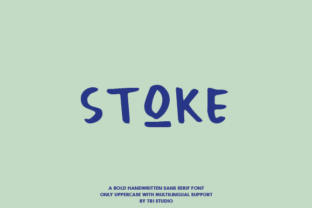
Stoke: Smart, Casual, Uniquely You
Stoke isn’t just another sans serif—it’s a quiet confidence in type form. Designed with intention but worn with ease, it bridges clarity and character in a way that feels both contemporary and timeless. Its open apertures, balanced proportions, and subtle stroke modulation give it strong legibility at small sizes, while its relaxed terminals and gentle rhythm lend warmth at larger scales. Unlike fonts that shout personality, Stoke suggests it—making it ideal for people who value substance *and* style without compromise.
Why Stoke Fits Real Creative Work
Designers reach for Stoke when they need reliability *with* resonance—like building a brand identity that communicates competence *and* approachability. Marketers use it in email headers and social banners because it holds attention without demanding it. Educators choose it for slide decks and handouts: clean enough for accessibility, expressive enough to feel human. Bloggers and small business owners find it especially useful when balancing professionalism with authenticity—think a local café’s menu board, a freelance illustrator’s portfolio site, or a nonprofit’s annual report.
What sets Stoke apart isn’t novelty for its own sake. It’s how thoughtfully its design decisions serve real-world use. The x-height is generous but not overwhelming. Letter spacing is calibrated for comfortable reading in UIs and long-form text. And its lowercase ‘a’ and ‘g’ carry just enough distinction to avoid monotony—without veering into distracting eccentricity.
Practical Ways to Use Stoke Across Projects
You don’t need a design degree to get meaningful results with Stoke. Here’s how different creators apply it—with purpose:
- Branding & Identity: Pair Stoke Regular with a single accent color and ample white space to build a calm, confident visual language. Try it for wordmarks (e.g., “Field Notes Co.”) where simplicity reinforces trust—not minimalism as an aesthetic, but as a signal of focus.
- Digital Interfaces: Use Stoke SemiBold for buttons and navigation labels—it’s sturdy enough to click, friendly enough to invite. In forms or dashboards, pair it with a neutral monospace (like JetBrains Mono) for data fields: contrast that clarifies hierarchy without sacrificing cohesion.
- Print & Packaging: On product labels or postcards, Stoke’s even texture ensures readability under varied lighting and at arm’s length. For a craft brewery’s can design, set the beer name in Stoke Bold and the description in Stoke Light—same family, clear visual pacing.
- Educational Materials: Teachers creating worksheets or presentation slides benefit from Stoke’s high legibility at 14–16pt. Its consistent stroke weight reduces visual fatigue during extended reading—especially helpful for neurodiverse learners or remote participants on smaller screens.
Adapting Stoke Thoughtfully—Not Just Stylistically
Using Stoke well means respecting its voice—not stretching it beyond its natural range. It thrives in contexts where clarity, warmth, and restraint matter more than drama or decoration. That means avoiding over-styling: excessive tracking, heavy faux-bold overrides, or layering multiple weights without clear hierarchy.
Instead, lean into its strengths:
- Start with one weight and one size—Stoke Regular at 18px for body copy—and adjust only when function demands it (e.g., switching to Bold for section headers).
- Let whitespace do the work. Stoke doesn’t need tight kerning or compressed line height to feel intentional. A generous 1.5 line-height and 1.2em paragraph spacing often yield better readability than typographic “tweaking.”
- Test across devices early. Its open counters and moderate contrast hold up well on low-DPI screens—but always preview how it renders in your CMS or email client, not just in design tools.
Ideas That Spark Action—Not Just Inspiration
Stoke works best when it supports a goal—not when it becomes the goal itself. Here are three grounded starting points:
- Redesign one recurring asset. Pick something you use weekly—a newsletter template, invoice header, or Instagram story grid—and rebuild it using only Stoke (plus one supporting font, if needed). Notice how consistency builds recognition—and how much faster future edits become.
- Run a tone check. Print two versions of a short landing page: one in Stoke, one in a default system font (like Helvetica or Inter). Ask a colleague: “Which version feels more like *us*?” The answer reveals more about your brand voice than any mood board.
- Build a micro-system. Define just three rules: (1) Stoke Bold for all primary headlines, (2) Stoke Regular for body and captions, (3) max two font sizes (e.g., 24px and 16px). Apply them everywhere for one week. You’ll see how constraint creates clarity—and frees mental space for bigger creative decisions.
Who Benefits Most—and Why
Freelancers appreciate Stoke because it reads as “I know what I’m doing”—without requiring hours of custom typesetting. Small business owners love that it scales: equally effective on a handwritten-style chalkboard sign and a polished Shopify homepage. Bloggers and educators find it accessible for readers *and* manageable for creators—no steep learning curve, no licensing surprises.
Even if you’re not a designer, Stoke lowers the barrier to making things look considered. You don’t need to master typography theory to pick a font that quietly elevates your message. You just need to ask: Does this help the reader understand—and feel welcome—while staying true to what matters? Stoke answers “yes” to both.
A Final Note on Originality
Using Stoke won’t make your work “unique” by default—but using it with intention will. Originality lives in how you combine it: the photography you pair it with, the voice you write in, the audience you serve. A restaurant owner using Stoke for their seasonal menu isn’t copying a trend—they’re signaling care in curation. A developer documenting an open-source tool in Stoke isn’t chasing aesthetics—they’re prioritizing comprehension.
That’s the quiet power of Stoke: it gives structure to your ideas without overshadowing them. It’s smart enough for serious work, casual enough to feel human—and uniquely adaptable to the people, platforms, and purposes you serve.