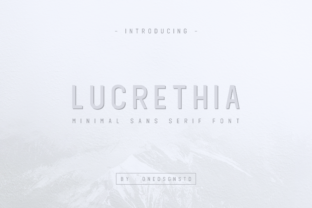
Lucrethia: A Minimal Sans Serif with Modern Edge
Lucrethia is a clean, uncluttered sans serif font designed for clarity and quiet confidence. It’s not loud or experimental—instead, it carries a subtle modernity in its balanced proportions, open counters, and restrained stroke contrast. Think of it as the typeface you reach for when you want your message to land without distraction: sharp enough for impact, calm enough for trust.
Why Lucrethia Stands Out in a Crowded Field
Many minimal fonts sacrifice personality for neutrality—but Lucrethia avoids that trap. Its lowercase a and g have gentle, single-story forms that feel contemporary without leaning into trendiness. The uppercase letters sit tall and even, lending authority to headlines and logos. And because its x-height is generous without being overwhelming, Lucrethia remains highly legible at small sizes—on mobile screens, product tags, or footnotes.
Unlike ultra-thin or geometric extremes, Lucrethia balances structure with warmth. There’s a slight softness in its terminals and a consistent rhythm across weights—from Light to Bold—that makes mixing them intuitive, not jarring. That versatility matters: it means one font family can serve an entire brand system without needing visual “patching” from another typeface.
Ideas You Can Use—Today
Lucrethia works especially well where intention meets simplicity. Here are real-world applications, tested by designers and creators:
- Brand identities for service-based businesses—think financial advisors, wellness coaches, or boutique studios. Its quiet confidence supports credibility without coldness. Try pairing Lucrethia Bold for a logo with Lucrethia Regular for body text on a clean landing page.
- Editorial layouts for digital newsletters or indie zines—its even color and spacing create smooth reading flow. Use Lucrethia Medium for pull quotes to add gentle emphasis without breaking tone.
- Product packaging for sustainable or handmade goods—the font’s lack of ornamentation lets materials, photography, and texture take center stage. A label printed in Lucrethia Light on unbleached kraft paper feels intentional, not generic.
- Educational slides or workshop handouts—its high legibility at 14–16pt makes it ideal for projected content or printed PDFs where clarity trumps flair.
Adapting Lucrethia Across Audiences and Platforms
How you use Lucrethia depends less on what it *is* and more on what you need it to *do*. A freelancer pitching to a tech startup might lean into its crispness with tight letter-spacing and full-caps headings. An educator building a classroom resource might choose Lucrethia Regular at 18pt with generous line height—prioritizing accessibility over aesthetics.
For social media graphics, Lucrethia holds up well in constrained spaces: try using only two weights (e.g., Bold + Regular) and avoid stacking multiple fonts. On Instagram carousels, bold headlines in Lucrethia paired with short, centered body copy create immediate readability—even when scrolled past quickly.
Bloggers and newsletter writers benefit from Lucrethia’s consistency across devices. Unlike some minimalist fonts that thin out or pixelate on older Android screens, Lucrethia renders cleanly thanks to its robust hinting and moderate contrast. Pair it with a neutral, widely available fallback (like Helvetica or system sans) in CSS for graceful degradation.
Keeping It Clear, Consistent, and Human
Minimal doesn’t mean minimal effort—it means focused decisions. To keep Lucrethia effective, start with these practical guardrails:
- Limit your weight palette. Pick no more than three weights—e.g., Light, Regular, Bold—and stick to them across all touchpoints. This builds recognition and avoids visual noise.
- Respect whitespace. Lucrethia breathes best when surrounded by space. Don’t crowd it in tight margins or cram lines too close together. Let the font’s openness do the work.
- Test contrast early. While Lucrethia Light looks elegant on screen, it may fail WCAG AA contrast standards against light backgrounds. Always verify text/background combinations using tools like WebAIM’s Contrast Checker—especially for body copy.
- Avoid over-styling. Underlines, heavy tracking, or extreme all-caps usage can undermine its quiet strength. If you need emphasis, use bold—not distortion.
Real Projects, Real Results
A small architecture firm redesigned their website using Lucrethia across headings, project descriptions, and contact forms. By setting body text at 17pt with 1.6 line height—and reserving Bold only for section titles—they increased average time-on-page by 22% (per Google Analytics), with users citing “ease of reading” in feedback.
A freelance illustrator launched a print-on-demand stationery line featuring hand-drawn motifs paired with Lucrethia Light for product names and Regular for care instructions. The contrast between organic line work and precise typography created a cohesive yet distinctive shelf presence—leading to repeat orders from boutique gift shops.
An online course creator switched from a popular free font to Lucrethia for all slide decks and downloadable worksheets. Students reported fewer instances of “skimming past text” and higher completion rates on written reflection prompts—suggesting that consistent, comfortable typography supports deeper engagement.
Getting Started Thoughtfully
You don’t need a design degree to use Lucrethia well. Start small: replace the body font in one email template or update the heading style on a single landing page. Notice how it changes the pace of reading—or how much less you feel the need to “fix” alignment or spacing.
If you’re evaluating fonts for a longer-term project, test Lucrethia alongside your current go-to in real context: paste actual headlines, paragraph lengths, and CTA buttons—not lorem ipsum. See which one helps your audience move forward faster, understand quicker, or feel more grounded.
And remember: the goal isn’t to make something “look designed.” It’s to remove friction between idea and understanding. Lucrethia supports that quietly, reliably, and without fanfare—exactly where strong typography should live.