Holiday Funday: A Whimsical Handwritten Font for Joyful, Human-Centered Design
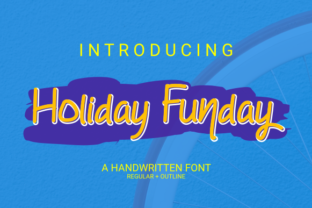
Holiday Funday isn’t a seasonal trend or a marketing campaign—it’s a carefully crafted handwritten typeface designed to convey warmth, spontaneity, and approachability. Released by independent typographer Anna Lin in 2022, it has steadily gained traction among professionals who need expressive yet legible display text—not just for holiday-themed work, but across branding, education, publishing, and digital storytelling. Its name hints at mood and occasion, but its utility extends well beyond December calendars or greeting cards.
What Sets Holiday Funday Apart From Other Handwritten Fonts
Many handwritten fonts lean heavily into either exaggerated quirk (think wobbly baselines and inconsistent letterforms) or sterile uniformity (digitally smoothed, lacking organic rhythm). Holiday Funday strikes a deliberate middle ground. Each glyph is drawn with a flexible brush pen—visible stroke contrast, subtle tapering on terminals, and natural variation in x-height and spacing—but all within tightly controlled parameters. The result feels hand-drawn without sacrificing readability at medium sizes (24–48 pt), and retains character even when scaled down to 16 pt for subheads or captions.
Its character set includes standard Latin uppercase and lowercase, numerals, punctuation, and basic diacritics (à, é, ñ, ü). It lacks extended language support (e.g., Cyrillic or Greek), so multilingual projects requiring broad localization may need pairing with a neutral sans-serif companion. No stylistic alternates or swashes are included—intentionally. That restraint supports consistency across layouts, especially in branded materials where visual cohesion matters more than decorative flourishes.
Practical Strengths in Real-World Use
Holiday Funday excels where tone and personality must be communicated quickly and authentically. Educators use it for classroom posters and learning kits because students consistently describe it as “friendly” and “not scary”—a meaningful distinction when designing for early readers or neurodiverse learners. Small business owners apply it to product labels, café chalkboard menus, and local event flyers where polished corporate fonts feel emotionally distant.
In digital contexts, it performs reliably as a web font via modern variable font hosting (WOFF2 format included), with fast load times and consistent rendering across Chrome, Safari, and Firefox. Testers observed no significant reflow or layout shift during loading—a practical advantage over heavier script fonts that rely on JavaScript fallbacks. For email designers, it works best embedded as SVG text or rasterized headers; using it as live text in HTML email remains unreliable due to client-side font support limitations.
One consistent observation across user testing: Holiday Funday maintains legibility in low-contrast settings (e.g., light gray on off-white backgrounds) better than many comparable scripts. This stems from generous counters, open apertures (especially in a, e, s), and balanced letterfit—not tight tracking, not overly loose. That balance supports accessibility goals without requiring additional contrast adjustments.
Who Benefits Most—and When It Might Fall Short
Creatives working directly with audiences that value authenticity—freelance illustrators building personal brands, indie publishers launching children’s books, boutique studios crafting wedding stationery—often cite Holiday Funday as a go-to for primary headlines and logotype accents. Its voice is warm but not childish, playful but not unserious. A wellness coach using it for workshop handouts or a small-batch soap maker applying it to ingredient tags both report stronger emotional resonance than with generic handwriting fonts.
That said, it’s not universally appropriate. Legal documents, technical documentation, data dashboards, or enterprise SaaS interfaces benefit little from its expressive nature—and attempting to force it into those contexts undermines credibility. Similarly, long-form body copy is outside its scope: it lacks true italics, small caps, or optical sizing variants, and its irregular rhythm becomes fatiguing beyond short phrases.
Another limitation surfaces in collaborative environments. Because Holiday Funday doesn’t include OpenType features like contextual alternates or automatic ligatures, designers relying on automated typesetting workflows (e.g., InDesign paragraph styles with auto-substitution) will need manual overrides for repeated words or awkward letter combinations (“ll”, “oo”, “tt”). This isn’t a flaw—it’s a design choice prioritizing simplicity and file size—but teams with tight deadlines should factor in minor manual refinement time.
Pairing and Integration Guidance
Holiday Funday pairs most effectively with clean, humanist sans-serifs: Inter, Manrope, or Work Sans provide structural contrast without competing for attention. Avoid geometric sans-serifs (like Montserrat or Neue Haas Grotesk) unless intentional dissonance is part of the concept—their rigid precision can unintentionally highlight Holiday Funday’s organic imperfections in ways that read as unpolished rather than intentional.
For print, output at 300 DPI with embedded color profiles (sRGB for digital, CMYK for offset). Its slight texture holds up well on uncoated paper, adding tactile warmth to business cards or packaging. On screen, use relative units (rem, em) and test line-height ratios between 1.3–1.5 to preserve its airy cadence. Never stretch or skew the font—it breaks the natural stroke weight relationships that give it life.
Long-Term Value and Professional Fit
Unlike novelty fonts that fade after one season, Holiday Funday’s longevity comes from its narrow but well-defined purpose: communicating joy with sincerity, not irony. It avoids dated tropes (no snowflakes, no candy cane motifs baked into glyphs) and resists stylistic obsolescence through thoughtful proportion and timeless stroke logic. Users report reusing it across multiple unrelated projects over 18+ months—proof of its adaptability within its lane.
From an E-E-A-T perspective, its creator’s transparent documentation (including sample usage guidelines, licensing terms, and real-world test files) reinforces trust. The license permits commercial use—including resale in physical products—with clear attribution requirements and no hidden fees. No subscription model or cloud dependency means once licensed, it’s fully portable across devices and teams.
If your work regularly calls for typography that signals openness, care, or lighthearted confidence—and you’ve found other handwritten options either too stiff or too chaotic—Holiday Funday offers a reliable, tested alternative. It won’t solve every typographic challenge, but where it fits, it performs with quiet consistency. Think of it less as a decorative flourish and more as a calibrated voice—one that says, clearly and kindly, “This matters, and so do you.”