Destined Duo: A Thoughtful Pairing of Sans Serif and Script
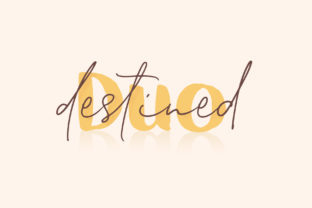
Destined Duo stands out not because it shouts, but because it balances. It’s a carefully considered font pairing—not a single typeface, and not a bundle of unrelated styles—but two distinct yet harmonious fonts designed to work together from the outset: a refined sans serif and an expressive, authentic script. That intentionality matters. In practice, this means less time testing combinations, fewer visual compromises, and more confidence when applying typography to real projects.
What Makes Destined Duo Different From Other Font Pairs?
Many “duo” or “bundle” offerings group fonts based on aesthetic similarity or licensing convenience—not functional synergy. Destined Duo avoids that trap. Its sans serif is clean and neutral without feeling sterile: even weights carry subtle warmth in their terminals and balanced proportions. Its script isn’t overly ornate or difficult to read at smaller sizes; instead, it features natural stroke variation, consistent baseline alignment, and genuine calligraphic rhythm—no forced flourishes or artificial ligatures. Both fonts share common x-heights, spacing tendencies, and optical sizing cues, making them feel like siblings rather than distant cousins.
This consistency translates directly into usability. When setting a headline in the script and body copy in the sans, the transition feels intentional—not jarring. You’re not compensating for mismatched metrics or manually adjusting tracking just to make the pair sit right.
Where Destined Duo Delivers Practical Value
Typography choices influence perception before a single word is read. Destined Duo supports clarity *and* character—two qualities often at odds. The sans serif performs well across interfaces, presentations, and printed collateral where legibility and neutrality are priorities. The script adds voice: ideal for invitations, brand signatures, editorial pull quotes, packaging accents, or short-form social graphics where personality matters.
Real-world examples illustrate its range:
- A local bakery uses the script for its logo lockup and seasonal menu headers, then switches to the sans for ingredient lists and operating hours—keeping tone cohesive without sacrificing readability.
- An independent course creator applies the script to section titles in a PDF workbook and the sans for explanations and exercises—guiding attention while maintaining accessibility.
- A boutique design studio selects the sans for client reports and proposals, reserving the script for personalized cover notes—adding warmth without undermining professionalism.
In each case, the pairing does more than look good. It reinforces hierarchy, supports narrative flow, and aligns visual language with audience expectations.
Quality and Technical Execution
Both fonts include full Latin character sets, standard punctuation, numerals, and basic diacritics—covering most English-language use cases out of the box. OpenType features are modest but purposeful: the script includes contextual alternates that improve letter connection logic, and the sans offers true small caps and proportional/lining figures. Neither font overloads with stylistic sets, which helps avoid decision fatigue and keeps file sizes lean.
Rendering is reliable across platforms. Tested in Figma, Adobe Creative Cloud, and modern web browsers (via variable font or static WOFF2 delivery), both fonts maintain their intended contrast and spacing. Kerning pairs are thoughtfully applied—not exhaustive, but sufficient for common word combinations. No noticeable hinting issues at standard UI sizes (14–18px), and the script remains legible down to ~20px in high-resolution contexts.
Flexibility Within Boundaries
Destined Duo isn’t built for maximalist experimentation. It won’t replace a full superfamily with 12 weights and matching italics. Its strength lies in focused utility—not breadth. That’s a feature, not a limitation, for users who value efficiency over endless options.
You can adjust contrast by choosing lighter or bolder weights within each family, but you won’t find condensed, ultra-bold, or monospace variants. Similarly, the script doesn’t include swash capitals or decorative dingbats. What you get is what’s needed to establish clear visual relationships—not decorative distractions.
This restraint supports long-term consistency. Brands using Destined Duo across touchpoints—from email footers to Instagram Stories—tend to maintain tighter typographic control because there are fewer “what if” decisions during execution.
Who Benefits Most—and When It Might Fall Short
Destined Duo serves creators who prioritize cohesion over complexity: freelancers managing multiple clients, small business owners handling their own marketing, educators designing course materials, or bloggers building recognizable visual identities. It’s especially useful when time is constrained but quality expectations remain high.
It fits naturally into workflows where typography plays a supporting—but essential—role: branding foundations, editorial layouts, presentation decks, product packaging, and digital signage. If your project relies heavily on data visualization, multilingual support beyond Western European languages, or extended typographic hierarchy (e.g., five-tier heading systems), you may need supplemental typefaces—or a more expansive system altogether.
Also worth noting: the script’s authenticity comes with mild trade-offs. At very small sizes (<16px) or low-resolution displays, some connections between letters soften slightly. That’s expected behavior for a script rooted in handwriting—not a flaw, but a cue to use it where its strengths shine: larger-scale, higher-fidelity applications.
Integrating Destined Duo Into Your Process
Start simple. Apply the script only where emphasis or voice is truly needed—logos, headlines, quotes—and default to the sans for everything else. Test contrast ratios early: ensure text remains WCAG-compliant, especially against colored backgrounds. Avoid stacking multiple script-heavy elements consecutively; let the sans create breathing room.
When exporting for web use, serve the fonts as WOFF2 files with appropriate font-display: swap settings to balance performance and visual stability. For print, embed both fonts fully and confirm glyph coverage matches your final text—particularly if using accented characters outside basic English.
Finally, treat Destined Duo as a tool—not a shortcut. Its value emerges when paired with thoughtful layout, intentional color, and purposeful content. It won’t compensate for weak messaging or inconsistent design decisions. But when used deliberately, it elevates work quietly and effectively.
A Last Observation
Good typography doesn’t draw attention to itself—it shapes how meaning is received. Destined Duo succeeds because it respects that principle. It doesn’t try to be everything. Instead, it delivers two well-made, mutually reinforcing voices—one calm and clear, the other warm and human—and trusts the designer to use them with judgment. For professionals balancing craft, constraints, and clarity, that kind of reliability is rare. And valuable.