Shailene Script
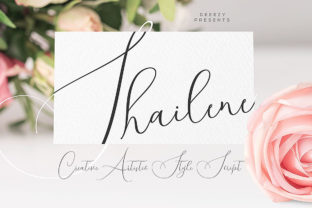
Shailene Script is a thin, delicate handwritten typeface designed with subtle romantic flourishes. It features flowing letterforms, soft contrast between thick and thin strokes, and an organic rhythm that evokes personal penmanship—without the irregularity of true freehand writing. Unlike many script fonts that prioritize dramatic swashes or high contrast, Shailene Script maintains visual lightness and even spacing, making it legible at moderate sizes while preserving its expressive character.
Why Designers Consider Shailene Script
Designers often seek typefaces that convey tone as much as function. Shailene Script appeals to those working on projects where elegance, intimacy, or quiet sophistication matters—such as wedding stationery, boutique branding, editorial features, or lifestyle packaging. Its restrained weight and gentle curves avoid overwhelming layouts, offering a quieter alternative to bolder scripts like Pacifico or Great Vibes. Because it’s digitally crafted—not scanned from real handwriting—it delivers consistency across characters and platforms, supporting reliable rendering in web and print environments.
Key Benefits
- Readability at moderate sizes: While not intended for body text, Shailene Script remains legible in headings, subheadings, and short labels (e.g., 24–48 pt), especially with adequate line spacing and contrast.
- Design versatility within its niche: It pairs well with clean sans-serifs (e.g., Inter, Lato) or low-contrast serifs (e.g., Merriweather), allowing designers to balance warmth and structure.
- Light visual weight: Its thin strokes contribute to airy, uncluttered compositions—valuable in minimalist or luxury-oriented designs where negative space is intentional.
- Cross-platform compatibility: Available in standard OpenType format, it supports common ligatures and basic OpenType features, and renders predictably in design software and modern browsers.
Tradeoffs and Practical Considerations
Like all script fonts, Shailene Script has functional limits. Its delicate strokes become fragile below ~18 pt, and fine details may blur or disappear in low-resolution outputs or on small mobile screens. It lacks extensive language support beyond basic Latin characters—no built-in Cyrillic, Greek, or extended diacritics—so multilingual projects may require fallbacks or custom work. Also, while it includes standard punctuation and numerals, alternate glyphs (e.g., stylistic sets or contextual alternates) are minimal, limiting typographic nuance compared to more robust script families.
Another consideration is licensing. Shailene Script is typically offered under desktop, web, and app licenses with usage tiers. Users deploying it on live websites must ensure their license covers the expected pageviews or domain count—especially if embedding via @font-face or third-party font services.
When Shailene Script Is a Strong Fit
Shailene Script excels in contexts where tone and subtlety outweigh functional demands for scalability or linguistic breadth. It works well for:
- Print-based materials with controlled output conditions—such as letterpress invitations, foil-stamped business cards, or premium product tags.
- Branding for businesses centered on care, craftsmanship, or personal connection: artisanal bakeries, independent bookshops, wellness studios, or handmade goods retailers.
- Editorial use in high-end magazines or digital features where headlines are large, isolated, and paired with generous whitespace.
- Short-form digital interfaces where hierarchy is clear and screen real estate allows for larger display sizes—like hero sections on portfolio sites or landing pages for creative services.
When Alternatives May Be More Appropriate
Shailene Script is less suitable when legibility, adaptability, or technical robustness are primary concerns. For example:
- Long-form digital reading: It should not be used for paragraphs, captions, or interface labels. A neutral, highly legible typeface—such as Source Sans Pro or Noto Serif—is preferable for body copy.
- High-contrast or bold visual statements: If a project calls for assertive energy or vintage flair, fonts like Allura, Alex Brush, or Dancing Script offer stronger personality and more pronounced swashes.
- Multilingual or global-facing applications: Projects requiring broad language coverage benefit from fonts like Playfair Display (with its script-inspired italic) or open-source alternatives like Italianno, which include expanded character sets.
- Dynamic or responsive environments: Where text must scale reliably across devices—such as mobile navigation menus or data dashboards—system fonts or variable sans-serifs provide greater control and performance.
Making an Informed Choice
Selecting a script font involves weighing expressive intent against practical constraints. Before choosing Shailene Script, ask: What is the dominant medium? Who is the audience—and what expectations do they bring? How much control do you have over size, color, background, and spacing?
Test it early in context. Render sample text at actual intended sizes on target devices. Check how it behaves over photographic backgrounds or textured surfaces. Compare it alongside potential pairing fonts—not just visually, but in terms of x-height alignment, stroke weight harmony, and overall rhythm.
Also consider workflow implications. Does your team use shared design systems or style guides? If so, confirm whether Shailene Script integrates cleanly with existing typography scales and spacing tokens. For developers, verify that the font file size stays within acceptable limits for web performance budgets—especially if loading multiple weights or styles.
Finally, reflect on longevity. Script fonts can date quickly if tied too closely to current trends. Shailene Script’s understated approach gives it moderate timelessness, but it still signals a specific aesthetic sensibility. Ensure that sensibility aligns not only with today’s goals but also with foreseeable brand evolution.
In summary, Shailene Script is a purpose-built tool—not a universal solution. Its value lies in its restraint and intentionality. When matched thoughtfully to context, audience, and execution constraints, it supports clarity of voice without sacrificing grace. But like any specialized typeface, its effectiveness depends less on inherent qualities and more on how deliberately it’s applied.